Ouroboros Linear Leios - Greater transaction throughput
Abstract
The anticipated growth of the Cardano ecosystem necessitates a fundamental enhancement of network throughput to accommodate increasing transaction volumes and support complex decentralized applications.
We propose Ouroboros Leios, an optimistic consensus protocol designed for high-throughput operation while preserving Ouroboros Praos security properties. Block producers simultaneously create both a standard Praos block and a larger secondary block referencing additional transactions. Secondary blocks undergo committee validation before ledger inclusion, enabling significantly higher throughput.
For a quick 5-minute overview of Ouroboros Leios, see our summary document.
For comprehensive research documentation, development history, and additional technical resources, visit the Leios Innovation R&D site at leios.cardano-scaling.org.
Motivation: Why is this CIP necessary?
Cardano's current throughput generally satisfies the immediate needs of its users. However, the Ouroboros Praos consensus protocol imposes inherent scalability limitations. To ensure timely and reliable global propagation of new blocks, the protocol requires that blocks be distributed across the network within a short time frame. This requirement forces a careful balance, restricting both the maximum size of individual blocks and the computational resources available for validating transactions and Plutus scripts. As a result, there is a fixed ceiling on the network's transaction throughput that cannot be raised by adjusting protocol parameters alone.
However, the dynamic growth of the Cardano ecosystem is increasingly revealing the practical consequences of these inherent limitations. The Cardano mainnet periodically experiences periods of significant congestion, where the volume of transactions awaiting processing surpasses the network's ability to include them in a timely manner. This congestion can lead to a tangible degradation in the user experience, manifesting as delays in transaction confirmation. Moreover, it poses substantial obstacles for specific use cases that rely on the efficient processing of large volumes of transactions, such as the distribution of tokens via airdrops, or the rapid and consistent updating of data by decentralized oracles or partner chains.
The semi-sequential nature of block propagation in Ouroboros Praos, where blocks are relayed from one block producer to the next across potentially geographically distant nodes, is a key factor contributing to these limitations. The necessity of completing this global dissemination within the few-second period places a fundamental constraint on the rate at which new blocks, and consequently the transactions they contain, can be added to the blockchain. This architectural characteristic stands in contrast to the largely untapped potential of the network's underlying infrastructure, where the computational and bandwidth resources of individual nodes often remain significantly underutilized.
To transcend these inherent scaling barriers and unlock the latent capacity of the Cardano network, a fundamental systematic evolution of the core consensus algorithm is imperative. Ouroboros Leios maintains Praos' sequential transaction processing model while introducing mechanisms for additional transaction capacity through Endorser Blocks, parallel validation workflows, and more efficient aggregation of transaction data. By reorganizing how transactions are proposed, validated, and ultimately recorded on the blockchain, this protocol upgrade seeks to achieve a substantial increase in the network's overall throughput, enabling it to handle a significantly greater volume of transactions within a given timeframe.
The Cardano Problem Statement CPS-18 Greater Transaction Throughput further motivates the need for higher transaction throughput and marshals quantitative evidence of existing mainnet bottlenecks. Realizing higher transaction rates is also necessary for long-term Cardano techno-economic viability as rewards contributions from the Reserve pot diminish: fees from more transactions will be needed to make up that deficit and keep sound the finances of stake pool operations.
A major protocol upgrade like Leios will take significant time to implement, test, and audit. It is therefore critical to have begun implementation well before transaction demand on mainnet exceeds the capabilities of Ouroboros Praos. The plot below shows the historically diminishing rewards and a forecast of their continued reduction: the forecast is mildly uncertain because the future pattern of staking behavior, transaction fees, and node efficiency might vary considerably.
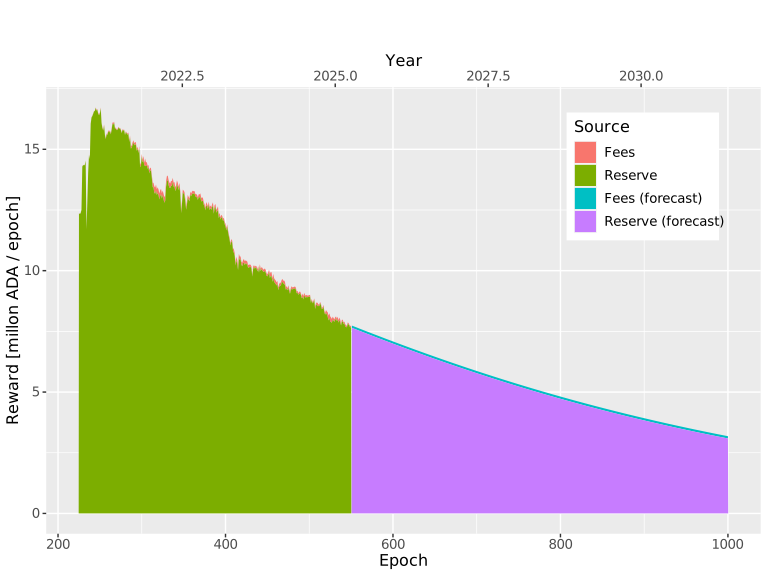
Ouroboros Praos cannot support the high transaction volume needed to generate the fees that will eventually be needed to offset the diminishing rewards. However, as sustained throughput of transactions grows beyond 50 transactions per second, there is more opportunity for simultaneously reducing fees, augmenting the Treasury, and increasing SPO and delegator rewards.
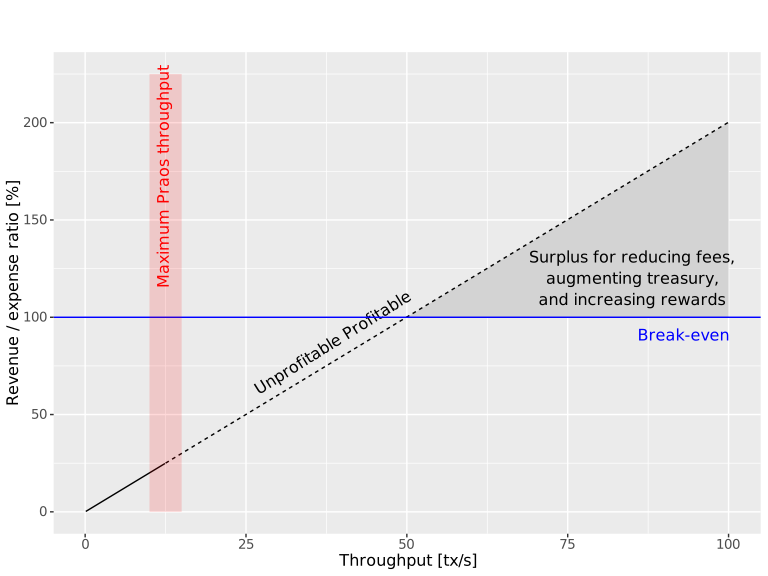
Figure 2: SPO profitability under Praos if the Reserves did not contribute to rewards, as a function of transaction volume.1
The Leios protocol specified in this document represents a balance between immediate scalability needs and long-term protocol evolution. The approach prioritizes practical deployment and ecosystem compatibility while establishing the foundation for subsequent protocol versions with higher throughput capacity.
Specification
Ouroboros Leios achieves higher transaction throughput by allowing block producers to create additional blocks alongside the regular Praos chain. These supplementary blocks, called Endorser Blocks (EBs), reference extra transactions that would otherwise wait for the standard Praos blocks (called Ranking Blocks or RBs in this protocol) in future active slots. To ensure data availability and correctness, these blocks undergo committee validation before their transactions become part of the permanent ledger.
The key insight is that we can maintain Praos' security guarantees while processing more transactions by carefully managing when and how these additional blocks are validated and included in the chain.
Note
The Agda formal specification for the proposed Leios protocol is available here.
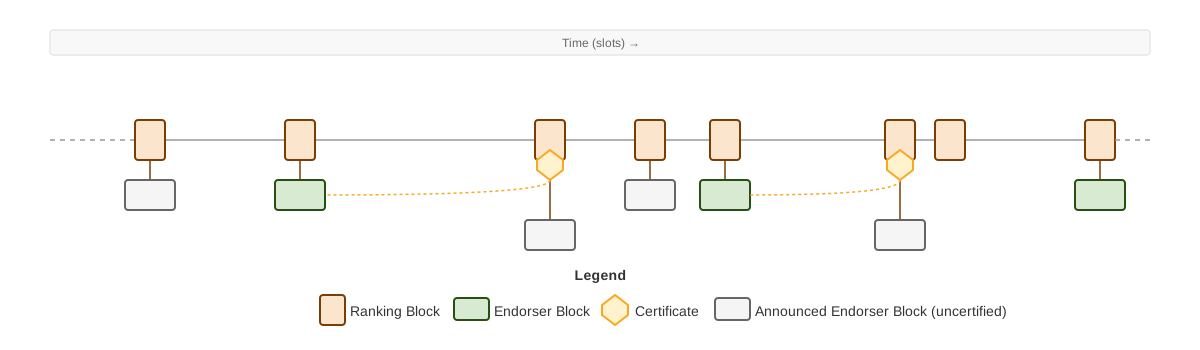
Figure 3: Leios chain structure showing the relationship between Ranking Blocks, Endorser Blocks, and Certificates
The horizontal spacing in Figure 3 reflects the opportunistic nature of EB inclusion: some EBs get certified and are included in the chain (green), while others cannot be certified in time (gray). This happens because Praos block production is probabilistic - some RBs will naturally occur before there has been sufficient time for the preceding EB to gather the necessary votes and certification, invalidating these EBs to become adopted. The key insight is that proposed Leios utilizes the natural intervals between Praos blocks to perform additional work on transaction processing without interfering with the base chain operation.
EB inclusion is therefore opportunistic rather than guaranteed, depending on the random timing of block production relative to the certification process. The precise timing mechanism is detailed in the following section.
Additionally, the reader should note the following implication: any RB that does not include a certificate may itself include transactions directly, so not all transactions go through EBs, even under congestion.
Protocol Flow
The protocol operates through five sequential steps that involve three critical timing constraints. Figure 4 visualizes the precise timing mechanism that governs when certificates can be safely included in the chain, showing both the underlying network characteristics ( values) and the protocol parameters ( values) that inform their design.
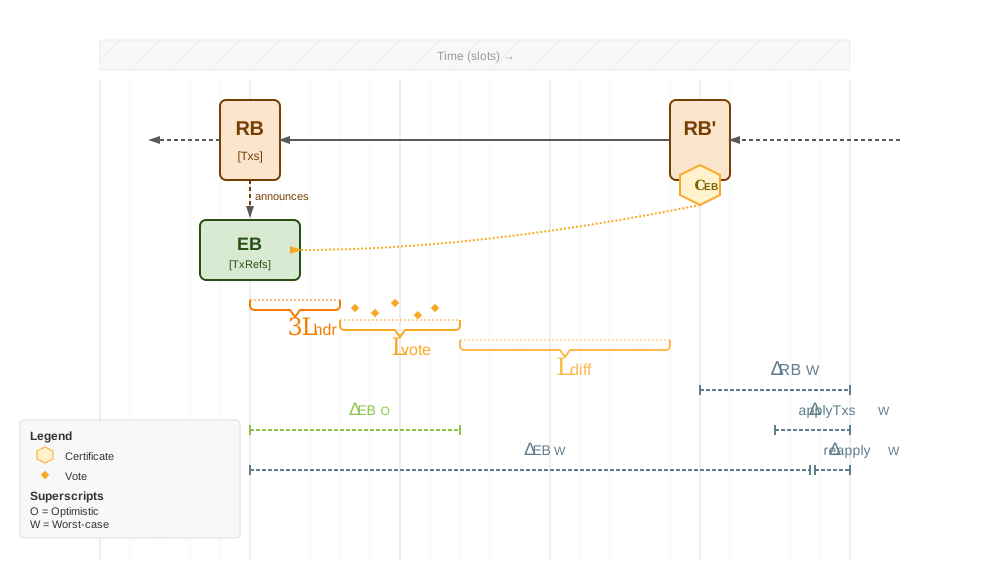
Figure 4: Detailed timing mechanism showing the three critical timing constraints for EB certification
Step 1: Block Production
Leios preserves the existing Praos chain structure while adding additional transaction capacity through EBs. When a stake pool wins slot leadership, it may create two objects:
- Ranking Block (RB) A standard Praos block with
extended header fields to optionally certify one previously announced EB and
optionally announce one EB for the next subsequent RB (i.e.,
RB') to optionally certify. - Endorser Block (EB) A larger block containing references to additional transactions.
The RB chain continues to be distributed exactly as in Praos, while Leios introduces separate distribution mechanisms for EB headers (for rapid discovery and equivocation detection), EB bodies, and their referenced transactions.
Due to the voting overhead per EB, EBs should only be announced if a transaction cannot be included in the base RB. Empty EBs should not be announced in the network as they induce a non-zero cost. Note that whether an RB is full is not solely determined by its byte size; in particular, the per-block Plutus limits could be the reason an RB cannot contain additional transactions. The lower latency provided by RBs naturally incentivizes their use first, enabling gradual adoption of Leios capabilities.
Step 2: EB Distribution
Nodes receiving the RB header discover the announced EB and fetch its body. The EB body contains references to transactions. If a node does not already possess a transaction referenced in the EB, it explicitly requests that transaction from peers. The whole process of propagating EBs and referenced transactions is called EB transmission. Only minimal validation is done before forwarding this data to ensure rapid dissemination while full validity is determined by the voting committee.
Minimal validation includes basic structural and cryptographic integrity checks (VRF verification, block hash validation, and header format verification).
Step 3: Committee Validation
After the equivocation detection period of , a voting committee of stake pools validates the EB and votes within a voting period . Committee members are determined by stake-based truncation at the epoch boundary. A committee member votes for an EB only if:
- The RB header arrived within ,
- It has not detected any equivocating RB header for the same slot,
- It finished validating the EB before slots after the EB slot,
- The EB is the one announced by the latest RB in the voter's current chain,
- The EB's transactions form a valid extension of the RB that announced it,
- The EB contains at least one transaction (i.e., is not empty), as specified in the formal specification.
where and are protocol parameters expressed as wall-clock durations. Voting is a node-local timer rather than a chain rule, so these two are used as durations directly, with no conversion to slots.
Step 4: Certification
During the voting period, if enough committee votes are collected such that the total stake exceeds a high threshold parameter (), for example 75%, the EB becomes certified:
The high voting threshold (e.g., 75%) ensures that any certified EB is already known to a large portion of the network (>25% even with 50% adversarial stake) by the end of the voting period. This widespread initial knowledge enables the network assumption that the EB will reach all honest parties within the additional diffusion period . See Protocol Parameters for details. A ranking block (RB) producer can then construct a compact certificate proving the EB's validity by aggregating the collected votes.
Step 5: Chain Inclusion
Block producers creating subsequent RBs (RB') may only include valid
certificates for the EB announced by a preceding block (RB) if sufficient time
has elapsed. See also Figure 4. Concretely, the inclusion rules are:
-
RB'contains eithera. a certificate for the EB announced in
RB, orb. a list of transactions forming a valid extension of
RB. -
Any included certificate must be valid as defined in Certificate Validation.
-
A certificate may only be included if
RB'is at leastslots after
RB. -
Regardless of whether
RB'includes a certificate, it may optionally announce its own EB for future certification.
where , and are
protocol parameters expressed as wall-clock
durations. Because the decision compares the slots of two blocks, that total is
converted to a whole number of slots using the genesis slotLength, rounded
up: rounding down would admit a certificate before the durations the
security argument relies on have actually elapsed. The
rounding is the only place slot granularity enters the timing rules, and at
mainnet's slotLength the division is exact for the values in
Table 7.
The certificate inclusion delay ensures certified EBs have sufficient time to diffuse throughout the network and do not impact protocol security. When a certificate is included, no further transactions are allowed in the RB for the same reason.
If transactions next to the certificate would be allowed, a validating node would need to build the ledger state from all endorsed transactions before it can validate the transactions in the same block, resulting in much stricter timing constraints to ensure protocol security.
If the next RB is produced before this minimum delay has elapsed, the EB certificate cannot be included and the EB is discarded.
Protocol Parameters
The protocol parameters are tunable values that can be adjusted via governance. These parameters fall into two categories: timing parameters derived from the network characteristics below and timing constraints, and size/resource parameters that manage throughput.
The certificate inclusion process (Steps 3-5) involves three timing constraints that work together to maintain Praos' security assumptions while enabling higher throughput. These constraints prevent scenarios where honest nodes would be forced to delay chain adoption due to missing data.
The protocol timing is built upon observed network characteristics that describe how quickly different types of data propagate. All timing parameters target propagation to ~95% of honest stake, which represents practical network-wide availability:
Table 1: Network Characteristics
Note
Network Condition
The exact definition of "optimistic" and "worst-case" network conditions may be refined based on empirical measurements and deployment experience. For example, optimistic conditions might be defined as "no fresher RB" or "at most 2 fresher RBs", depending on how these conditions impact throughput and . The specific thresholds should be determined through testnet validation and performance analysis.
Table 2: Ledger Characteristics
Protocol Parameters
| Parameter | Symbol | Units | Description | Rationale |
|---|---|---|---|---|
| Committee size | seats | Number of top-stake pools seated on the epoch's voting committee | Directly bounds votes per EB and certificate size. Governed from the stake distribution so that covered stake exceeds with headroom; see feasible values. | |
| Quorum stake threshold | fraction | Minimum fraction of total active stake that must be represented by votes in a certificate | Safety-critical. Must satisfy , and leave a sizable of honest stake for the assumption; see choosing the quorum threshold. | |
| Header diffusion period length | seconds | Duration for RB headers to propagate network-wide | Per equivocation detection: must accommodate header propagation for equivocation detection. | |
| Voting period length | seconds | Duration during which committee members can vote on endorser blocks | Per voting period: must accommodate EB propagation and validation time. Set to minimum value that ensures honest parties can participate in voting | |
| Diffusion period length | seconds | Additional period after voting to ensure network-wide EB availability | Per diffusion period: derived from the fundamental safety constraint. Leverages the network assumption that data known to >25% of nodes propagates fully within this time | |
| Maximum endorser block size | bytes | Maximum size of an endorser block itself | Limits EB size to ensure timely diffusion; prevents issues with many small transactions | |
| Maximum total transaction size per endorser block | bytes | Maximum total size of transactions that can be endorsed by an endorser block | Limits total transaction payload to ensure timely diffusion within stage length | |
| Maximum reference script size per endorser block | bytes | Maximum total size of reference scripts used by the transactions endorsed by an endorser block | The EB analogue of the Praos per-block maxRefScriptSizePerBlock: bounds the script bytes that must be loaded from the UTxO and evaluated per EB, which the EB's own size does not account for. | |
| Maximum Plutus steps per endorser block | - | step units | Maximum computational steps allowed for Plutus scripts in a single endorser block | Limits computational resources per EB to ensure timely validation |
| Maximum Plutus memory per endorser block | - | memory units | Maximum memory allowed for Plutus scripts in a single endorser block | Limits memory resources per EB to ensure timely validation |
Table 3: Protocol Parameters
Note
While per-transaction limits could be increased based on the evidence, the choice was made to deliberately only introduce per-endorser-block limits to avoid escalation of a threat: throughput-lowering attacks on certification would violate liveness of high plutus budget transactions.
For example, a 26% stake attacker can trivially attack leios throughput with a 75% certification threshold. If an application would rely on higher (than what is available in praos) plutus demand transactions, those would not get included at all during such an attack.
Despite, an application can work around this by splitting intense plutus work into multiple transactions and chaining them into, potentially, the same endorser block.
Timing parameters
There are three key parameters related to time, which are important for protocol security. All relevant quantities are depicted in Figure 4.
These three are wall-clock durations in seconds, not slot counts, specified
the way the genesis slotLength is (see CIP-0009). Each is derived from
a network propagation time from Table 1, which is a wall-clock
quantity, so expressing them in slots would couple Leios timing to slotLength
and silently retune the protocol whenever that changed. At mainnet's
slotLength of one second the two readings coincide, which is why the values in
Table 7 are unchanged from earlier slot-denominated drafts.
Equivocation Detection ()
Equivocation is the malicious behavior where a block producer creates multiple conflicting blocks for the same slot and distributes different versions to different parts of the network. This attack aims to split the honest vote, potentially preventing certification of any block or allowing certification of an adversarial block if honest nodes vote on different versions.
This period starts exactly when an RB announces an EB. During this time, the network detects any attempts by adversaries to create multiple conflicting blocks for the same slot. The equivocation detection mechanism ensures that honest nodes can reliably identify and reject equivocating behavior before participating in voting. The equivocation detection period is , derived from the header diffusion parameter .
Equivocation Attack Model: An adversary controlling a block production slot may attempt to create multiple conflicting EBs and distribute different versions to different parts of the network. This could potentially split the honest vote, preventing certification of any EB, or worse, allow certification of an adversarial EB if honest nodes vote on different versions.
Detection Mechanism: The protocol defends against equivocation through a multi-step detection process that must accommodate the worst-case propagation scenario:
- : Initial header propagation — the first (honest or adversarial) RB header reaches all honest nodes
- : Conflicting header propagation — any equivocating header from the same slot reaches honest nodes
- : Equivocation evidence propagation — proof of conflicting headers propagates network-wide, allowing all honest nodes to detect the equivocation
Therefore, the equivocation detection period is to ensure reliable detection before voting begins. This constraint is derived from the network model where headers must propagate within to maintain Praos security assumptions.
Security Guarantee: By waiting before voting begins, the protocol ensures that if any equivocation occurred soon enough to matter, all honest nodes will have detected it and will refuse to vote for any EB from an RB slot where equivocation was detected. This prevents adversaries from exploiting network partitions to gain unfair advantages in the voting process, as honest nodes will only vote for EBs where no equivocation was detected during the detection period.
Note that EB diffusion (but not voting) continues to happen during this phase.
Note
Comparison with Research Paper: The Leios research paper describes a more complex protocol variant that requires for equivocation detection due to additional coordination mechanisms between Input Blocks (a third block type in the research paper, eliminated in this specification) and Endorser Blocks. This specification's simplified approach, where EBs are directly announced by RBs, reduces the equivocation detection requirement to while maintaining the same security guarantees against equivocation attacks.
Voting Period ()
The voting period must accommodate EB diffusion (transmission and processing):
where (optimistic EB diffusion time including transmission and processing) is defined in the network characteristics section.
This ensures all honest committee members can participate by having sufficient time to:
- Receive the EB from the network
- Fully validate it (verify signatures, execute scripts, update state)
Diffusion Period ()
The diffusion period ensures network-wide EB availability through a combination of factors: the high quorum stake threshold ensures certified EBs are initially known to holders of at least of honest stake. That is, >25% at against the adversarial stake of the threat model, since an honest pool votes only after fully validating the EB. This enables the network assumption about data that was provably present with such widespread initial knowledge propagates fully to the remaining stake within this period. Keeping that remainder sizable is therefore a constraint on (see choosing the quorum threshold). The diffusion period must satisfy:
This ensures certified EBs reach all honest parties before any RB' that
includes their certificate needs processing.
Size parameters
Three separate parameters control EB sizes:
- limits the size of the EB data structure itself, preventing issues when many small transactions create large numbers of transaction references (32 bytes each)
- limits the total size of transactions that can be referenced, controlling the actual transaction payload
- limits the total size of reference scripts those transactions use, controlling script bytes that are loaded from the UTxO rather than carried by the EB
Note that does not change the maximum size of individual
transactions. The existing maxTxSize parameter remains unchanged and continues
to limit individual transaction sizes. The purpose of is to
limit the total computational work required for validation and ledger state
updates when processing an EB, since the EB size itself does not account for the
full size of all referenced transaction data that must be validated.
stands in the same relation to maxRefScriptSizePerBlock as
does to maxBlockBodySize: reference scripts live in the UTxO
and so are counted by neither nor , yet they must be
loaded and evaluated to validate an EB. The per-transaction
maxRefScriptSizePerTx likewise remains unchanged, and the Praos per-block limit
continues to apply to RBs.
For example, an EB referencing 10,000 transactions of 100 bytes each would have MB but the EB itself would be at least 320 KB for the transaction hashes alone.
Protocol Security
Leios security reduces to Praos security. The key insight is ensuring that any RB containing an EB certificate is processed within the same time bound as standard Praos blocks.
1. EB Reapplication Constraint
Reapplying a certified EB cannot cost more than standard transaction processing.
2. Certified EB Transmission Constraint
Any certified EB referenced by an RB must be transmitted (but not necessarily be processed) before that RB needs to be processed.
The security argument can now be described. For simplicity, the analysis focuses on the case where a single RB (referencing an EB) is diffused, and nodes have already computed the ledger state that this RB extends.
The argument proceeds as follows: (i) The certified EB that the RB references will be received within from the initial diffusion time of the RB. This follows directly from Constraint 2 and the fact that the RB was generated at least after the EB was generated. (ii) The RB will be processed within slots, due to the fact that it is received within from its initial diffusion time, and processing in the worst-case takes slots according to Constraint 1.
Given that nodes are caught up when they are about to produce or process an RB, Praos safety and liveness is thus preserved.
Note that a sizable remainder of — the honest stake that must have received and fully validated a certified EB in order to vote for it — is what makes attainable in the first place, together with concrete stake-based sampling of the committee and an appropriate fetching policy; see choosing the quorum threshold.
Protocol Artifacts
The protocol extends Praos blocks, introduces endorser blocks, Leios votes and certificates. While already introduced briefly, this section specifies these artifacts in more detail.
Ranking Blocks (RBs)
RBs are Praos blocks extended to support Leios by optionally announcing EBs in their headers and embedding EB certificates in their bodies.
-
Header additions:
announced_eb(optional): Hash of the EB created by this block producerannounced_eb_size(optional): Size in bytes of the announced EB (4 bytes)certified_eb(optional): Single bit indicating whether this RB certifies the EB announced by the previous RB (the EB hash is already available via the previous header'sannounced_ebfield)
-
Body additions:
eb_certificate(optional): aggregated certificate proving EB validity- Transactions (when no certificate is included)
A CDDL for ranking blocks is available in Appendix B.
- When an RB header sets
certified_ebto true, the corresponding body must include a matchingeb_certificate - The content rules for RBs are detailed as part of Step 5: Chain Inclusion
- The
certified_ebbit enables syncing nodes to predict the total size of valid responses to their requests for batches of EBs certified on the historical chain. - If the
announced_eb_sizefield of an RB header is incorrect, then neither the RB header nor the RB are invalid. But no honest node should vote for the EB.
Endorser Blocks (EBs)
EBs are produced by the same stake pool that created the corresponding announcing RB and reference additional transactions to increase throughput beyond what is permitted to be included directly in the RB.
EB Structure: EBs have a simple structure:
transaction_references: Ordered map from transaction hash to transaction size, preserving insertion order while preventing duplicate entries and ensuring deterministic serialization
A CDDL for endorser blocks is available in Appendix B.
The hash referenced in RB headers (announced_eb field) is computed from the
complete EB structure and serves as the unique identifier for the EB.
Votes and Certificates
Leios employs a voting and certificate scheme where committee members cast votes that reference specific EBs, which are then aggregated into compact certificates for inclusion in RBs. This specification uses BLS signatures as the implementation example, though the protocol is designed to accommodate any efficient aggregate signature scheme that Cardano may adopt.
The implementation meets the requirements for votes and certificates specified in Appendix A. Alternative schemes satisfying these requirements could be substituted, enabling unified voting infrastructure across Ouroboros Leios, Ouroboros Peras, and other protocols.
To participate in the Leios protocol as voting member/ block producing node, stake pool operators must register one additional cryptographic key for the voting scheme alongside their existing VRF and KES keys. In the BLS implementation described here, this would be a BLS key over the BLS12-381 elliptic curve.
Key Registration and Rotation: The proposed mechanism is to extend the existing stake pool registration certificate to carry the voting key, rather than introduce a dedicated certificate or place the key in the block header. Extending the pool registration certificate binds the voting key's lifecycle to the pool's — registered, re-registered, and retired together — and reuses the authorization already required to register a pool, adding no new certificate type or witnessing rule. A dedicated certificate would also work but adds a new type and lifecycle to specify and maintain; a header-carried key (analogous to the VRF key and signed by the KES key) was likewise considered and would let the key ride the operational-certificate path, at the cost of requiring the ledger to observe block headers.
The registered key material is a public key together with a proof of possession
carried in an optional bls_key field of the pool registration certificate (see
Pool Registration in Appendix B). The proof of
possession is mandatory and verified at registration: BLS aggregate signatures
are otherwise vulnerable to rogue-key attacks, in which an adversary registers a
key crafted relative to others' keys so that an aggregate appears to include
voters who never signed. Only a key with a valid proof of possession may occupy
a committee seat or contribute to a certificate. Because committee membership is
stake-based (see Committee Structure), a pool may be
selected by stake without having registered a valid voting key; such a seat is
keyless — it cannot sign, and any certificate marking a keyless seat as a
signer must be rejected.
Voting keys rotate on a cadence comparable to KES key rotation (~90 days on Cardano mainnet), which a corresponding key time-to-live should enforce. This is distinct from KES key evolution (~12 hours): evolution provides forward secrecy within a single key's lifetime and is not required for voting keys. Unlike a KES key, which takes effect immediately on the chain it is used to build, a voting key must be activated at an epoch boundary, because the committee is fixed once per epoch from the stake distribution — so a voting key's activation resembles that of a VRF key.
A voting key could in principle activate sooner than a VRF key: VRF keys are held back to prevent grinding of the leader-election nonce, a concern voting keys do not share, so a registered voting key could become active as soon as the stake snapshot it appears in stabilizes. The recommended design nonetheless aligns voting-key activation with VRF-key rotation. Activation is not merely an on-chain event — an operator must install the newly-active key on the hot, block-producing machine for the epoch in which it becomes effective — so a staggered schedule would force an operator who rotates both keys in one epoch to perform two separate hot-key swaps in consecutive epochs. Aligning the two schedules collapses this into a single swap, trading a slightly longer window in which the new key is registered but not yet active for materially simpler key handling. A newly registered or rotated key is not eligible to vote until the snapshot in which it appears becomes active; a committee that must be live from the first epoch (e.g. at genesis) therefore requires its keys to be present in the initial stake snapshots.
Committee
Structure: The voting committee for an epoch is determined by stake-based
truncation of the active stake distribution: it is the top pools by
active stake, where is the committeeSize protocol parameter. At the
epoch boundary, pools are ordered by active stake in descending order (ties
broken by pool ID in ascending order) and the first are seated; if fewer
than pools are registered, all of them are seated. The resulting committee
is fixed for the entire epoch; every committee member is eligible to vote on
every EB produced within that epoch, and every vote carries the weight of its
pool's active stake.
Because each seat carries its own pool's stake and the quorum is a predicate on stake, a seat count cannot mis-weight or under-represent any pool. It only decides how much active stake is eligible to vote, and that is the whole of what setting it wrong can do: if is too low, the seated pools together hold less than of active stake, and then no certificate can meet the threshold even when every single committee member votes in favour of the same EB announcement.
What does leave to governance is coverage: the share of active stake held by the top pools, written , drifts as stake moves between pools, and liveness requires it to stay above with headroom for members that are offline, keyless, or too slow to vote within .
is accordingly a liveness parameter, not a safety-critical one: it decides which pools may vote, never whether a certificate is valid. The quorum threshold is the safety-critical parameter of the voting layer: it is the predicate a certificate must prove, and must exceed by a clear margin. Feasible Protocol Parameters gives the guidance for choosing both, and the rationale for this scheme over the alternatives considered is recorded in Design Decisions.
The certificate accordingly consists of a bitfield indicating which committee members signed plus a single aggregated BLS signature. Its size grows linearly in committee size, dominated by the bitfield ( bytes) plus a fixed signature and overhead.
Vote Structure: Votes are cast on EB announcements, which uniquely identifies an EB extending a Praos chain and have the following structure:
announcing_rb_hash: Announcement to vote on; a hash of the RB header pointing to an EB viaannounced_eb.voter_id: Index into the epoch's stake-based committee (pools ordered by descending stake at the epoch boundary; see Committee Selection)vote_signature: BLS signature overannouncing_rb_hash
Votes do not carry eligibility proofs. Eligibility is determined by epoch-level committee membership and verified by direct lookup against the committee derived at the epoch boundary.
Binding the vote to announcing_rb_hash ensures voters validated the EB against
the same ledger state it extends when certified on chain; recall that multiple
RB headers could announce the same EB.
A CDDL for votes and certificates is available in Appendix B.
Certificate Validation: When an RB includes an EB certificate, nodes must validate the following before accepting the block:
-
CDDL Format Compliance: Certificate structure matches the specification format defined in the Votes and Certificates CDDL specification in Appendix B
-
Cryptographic Signatures: The cryptographic signature is valid (BLS signatures in this implementation)
-
Voter Eligibility: Each signing voter must be a member of the epoch's stake-based committee, selected from the active stake distribution at the epoch boundary.
-
Stake Verification: Total voting stake meets the required quorum threshold
-
Announcement Consistency: The certificate verifies against the hash of the announcing RB header, which is determined from the certifying RB's chain context rather than carried in the certificate
Formal pen-and-paper algorithms for the voting and certificate scheme are given in the ARC voting crypto review (the scheme in this CIP corresponds to "Truncation" in that report). Benchmarks and implementation details are available in leios-wfa-ls-demo.
Note
Vote Bundling
The linked BLS specification mentions vote bundling as an optimization. However, this only applies when EB production is decoupled from RBs, which is not the case in this specification where each EB is announced by an RB.
Node Behavior
The Leios protocol introduces new node responsibilities and message flows beyond those in Praos, reflecting the additional steps of EB creation and announcement, committee voting, and certificate aggregation. The following sections detail the specific behaviors that nodes must implement.
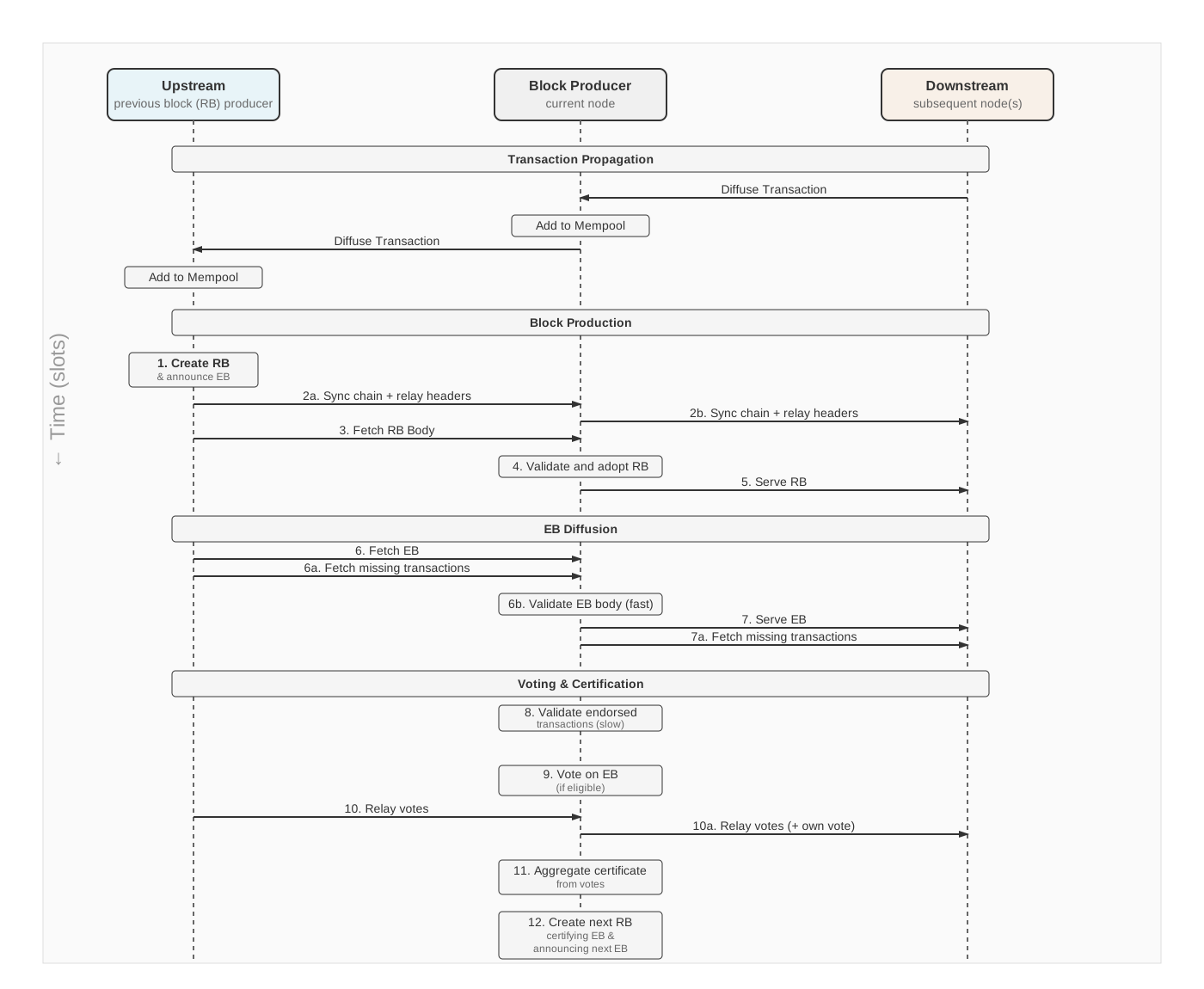
The diagram above illustrates the Leios protocol in a simplified sequential order. In practice, these operations occur concurrently and the actual execution order depends on network conditions, timing, and node state. While many steps introduce new behaviors, several core Praos mechanisms remain unchanged.
Transaction Diffusion
Transaction Propagation: Uses the TxSubmission mini-protocol exactly as implemented in Praos. Transactions flow from downstream to upstream nodes through diffusion, where they are validated against the current ledger state before being added to local mempools. The protocol maintains the same FIFO ordering and duplicate-detection mechanisms.
Mempool Design: The mempool follows the same design as current Praos deployment with increased capacity to support both RB and EB production. A node's mempool capacity must accommodate expanded transaction volume:
Nodes maintain a set of transactions seen in EBs to enable validation work reuse, with detailed processing rules specified in the EB transaction handling section.
RB Block Production and Diffusion
When a stake pool wins slot leadership (step 1), they create a Ranking Block (RB) and optionally an Endorser Block (EB) based on the chain inclusion rules. The RB is a standard Praos block with extended header fields to reference one EB and announce another EB when such is created. The optional EB is a larger block containing references to additional transactions. The RB chain continues to be distributed exactly as in Praos, while Leios introduces a separate mechanism to distribute the same headers for rapid EB discovery and equivocation detection.
RB Header Diffusion: RB headers diffuse independently of standard ChainSync (steps 2a and 2b). This separate mechanism enables rapid EB discovery within the strict timing bound . EBs are diffused freshest-first to facilitate timely EB delivery, with nodes propagating at most two headers per (slot, issuer) pair to detect equivocation - where an attacker creates multiple EBs for the same block generation opportunity — while limiting network overhead. The header contains the EB hash when the block producer created an EB, allowing peers to discover the corresponding EB.
RB Body Diffusion: After receiving headers, nodes fetch RB bodies via standard BlockFetch protocol (step 3). This employs ChainSync and BlockFetch protocols without modification for fetching complete ranking blocks after headers are received. The pipelining and batching optimizations for block body transfer remain unchanged from Praos.
Validation and Adoption: Nodes validate the RB and any included EB certificate before adopting the block (step 4). This includes cryptographic verification of certificates and ensuring they correspond to properly announced EBs. The complete validation procedure is detailed in Step 5: Chain Inclusion. The node serves RBs to downstream peers using standard Praos block distribution mechanisms (step 5), which are permitted to include diffusion pipelining with delayed validation.
EB Diffusion
Whenever an EB is announced through an RB header, nodes must fetch the EB content promptly (step 6), such that they receive it within and consequently enables them to vote. EBs are fetched freshest-first to ensure timely delivery within the voting window. Only the EB body corresponding to the first EB announcement/RB header received for a given RB creation opportunity shall be downloaded. The EB contains references to transactions.
EB Propagation for Chain Selection: To support efficient chain selection, nodes must receive all EBs from competing forks, not only those in their current preferred chain. This ensures that when a node switches to a different fork due to the longest-chain rule, it can immediately validate the new chain without additional EB propagation delays. However, nodes do not need to fetch EBs from forks that have diverged from the locally preferred chain older than the Praos security parameter, as such forks cannot affect chain selection decisions. EBs are forwarded before complete validity checks are performed.
Transaction Retrieval: Nodes check their local mempool for the transactions referenced by an EB and fetch any missing ones from peers (steps 6a and 7a). Once a node has successfully secured all of the referenced transactions, it can serve the EB to its downstream peers (step 7). This guarantees that when a peer receives an EB from it, all the referenced transaction data is already available at the source.
Transaction Validation: As endorsed transactions become available, nodes validate them in the endorsed sequence against the appropriate ledger state (step 8), ensuring the transactions form a valid extension of the announcing RB and meet size constraints.
To optimize validation work, nodes maintain a set of transactions seen in recently received EBs. Each entry in contains:
- The transaction itself
- A validation flag indicating whether the transaction has been verified (signatures, scripts, etc.)
Transactions are only validated when they are seen the first time, either in the mempool or as part of an EB, and validity information is retained to avoid redundant fetching and validation.
Voting & Certification
Voting Process: Committee members (determined deterministically at the epoch boundary by stake-based truncation) vote on EBs as soon as vote requirements are met according to protocol (step 9). An honest node casts only one vote for the EB extending its current longest chain.
Vote Propagation: Votes propagate through the network during the vote diffusion period slots (steps 10 and 10a). While nodes forward votes on EBs across all candidate chains, they only forward at most one vote per committee member per slot.
Nodes maintain and relay votes for a bounded duration to limit resource usage. Since freshest-first delivery ensures that newer votes are prioritized over older ones, the exact bound is not critical for protocol correctness. A conservative bound of a few minutes is sufficient to handle network delays while allowing nodes to discard votes that are no longer relevant.
Certificate Construction: All nodes receive votes from upstream peers, maintaining a running tally for each EB to track progress toward the quorum threshold (step 11). However, only RB producers create certificates when they are about to produce a new ranking block. Block producing nodes know their own leadership schedule, so they know when they are eligible to construct a certificate for an upcoming RB they will produce. When enough votes are collected during the vote diffusion period, the RB producer aggregates them into a compact certificate. This certificate is embedded directly in the RB body and serves as cryptographic proof that the EB has received sufficient committee approval.
Next Block Production
Certificate Inclusion: Block producers creating new RBs include certificates for EBs where at least have elapsed since the slot of the RB that announced the EB (step 12), rounded up to a whole number of slots as specified in Chain Inclusion. This timing constraint ensures the certified EB has had sufficient time to diffuse throughout the network. See the protocol flow section for detailed block production and inclusion rules.
Ledger Management
Ledger Formation: The ledger follows the same design as Praos with the addition of certificate handling and EB attachment references. The ledger state is updated according to the same validation rules used in Praos, with phase-1 and phase-2 validation applying equally to both RB and EB transactions.
State Transitions: EBs add transactions to the ledger only when properly certified and included via RB references. RBs can include both certificates and their own transactions. The ledger state for validating RB transactions is constructed based on either the predecessor RB (when no EB certificate is included) or the certified EB (when a valid certificate is present). Note that EB transactions are validated against the ledger state from the RB that announced the EB (i.e., the predecessor RB of the certifying RB), ensuring the predecessor RB's transactions are relevant in both validation scenarios.
Chain Selection: Chain selection follows the densest chain rule as in Ouroboros Genesis. EBs are treated as auxiliary data that do not affect chain validity or selection decisions. Fork choice depends solely on RB chain density, with EB certificates serving only as inclusion proofs for transaction content. The EB propagation for chain selection requirement ensures that nodes already possess all necessary EBs from alternative forks, eliminating additional propagation delays during fork switches.
Epoch Boundary
Committee Selection: Nodes must compute the voting committee for each epoch from the stake distribution available at the epoch boundary. The procedure is:
- Order pools by active stake, descending, breaking ties by pool ID ascending (byte-wise on the pool's key hash).
- Take the first pools, or all of them if fewer than are registered.
- Fix the resulting list as the epoch's voting committee; a pool's position in
this order is its seat index, which its votes carry as
voter_id.
Nodes complete this computation well before voting begins in the new epoch to ensure seamless participation.
Operational certificate issue numbers
Each node must relay at most two EB announcements that equivocate the same Praos election. This would be trivial for senders and receivers to enforce, if it were not for operational certificates, which complicate the notion of which sets of headers qualify as equivocating.
With the current Praos system, an SPO is free to issue an arbitrary operational certificate issue number (OCIN) every time they issue an RB header, but honest SPOs will only increment their OCIN when they need to. Whether the OCIN carried by some header is valid depends on the chain it extends, because the Praos protocol rules along a single chain only allow an SPO's OCIN to be incremented at most once per header issued by that SPO.
The Leios protocol, in contrast, is expected to diffuse contemporary EBs regardless of which chain they are on, and so cannot assume that it has seen the predecessor header of every EB announcement. It also cannot simply require that it has seen all headers, because that would complicate the timing restrictions and require tracking a potentially unbounded number of forks. Thus, neither of the following simple extremes would be acceptable for Leios.
- If Leios ignores OCINs, then a leaked hot key would let the adversary issue impersonating EBs whenever the stake pool is elected until that KES period expires, which can be up to 90 days later on Cardano mainnet. That's unacceptably long. (Significantly shortening the KES period is not an option, because that would excessively burden SPOs by forcing them to utilize their cold key more often.)
- If Leios instead over-interprets distinct OCINs as separate elections, then any adversary can diffuse any number of EB announcements per actual election, with arbitrary OCINs. Those announcements would be an unacceptable unbounded burst of work for honest nodes to relay throughout the entire network, even if they still only relayed at most one EB body per actual election.
There is no simple compromise between those extrema. In particular, if there's any way for the adversary to have revealed incremented OCINs to some nodes but definitely not all, then the worst-case diffusion behavior of adversarial EBs might be worse than that of honest EBs, which would complicate the acceptable lower bound on , for example. On the other hand, if every OCIN increment — even those disallowed by Praos — is always eventually relayed to all nodes, then an adversary can create unbounded work by constantly incrementing their OCINs. In the absence of the context provided by forks, there's no bound on the OCINs the Leios protocol would relay.
Thus, the diffusion of EB announcements (regardless of who issued them) is only tractable and robust if it is restricted to a bounded set of OCINs that all honest nodes almost certainly agree on. For this reason, the Leios node should ignore an EB announcement that is less than the OCIN on its settled ledger state or more than one greater than that OCIN. After not ignoring two announcements with the same election, the Leios node should ignore (including not relaying) any subsequent announcements for that election.
With this rule, a node will crucially disconnect if and only if a peer sends more than two announcements with the same election. It will also ignore headers from leaked hot keys once the SPO increments their OCIN, but unfortunately — and in contrast to Praos — not immediately. The Leios node will only ignore unincremented OCINs after all honest nodes necessarily agree that the SPO incremented their OCIN. In the strictest case, that could require the increment to be at least 36 hr old on Cardano mainnet before Leios ignores the unincremented OCIN. It seems plausible that the agreement could sometimes be assumed sooner (e.g., after a certificate includes the incremented OCIN), but further details are not a blocker for this CIP; 36 hr is already an acceptable improvement over 90 days, and SPOs already must not frequently leak their hot keys.
Network
Unlike Ouroboros Praos, where the RB chain contains all necessary data, Leios requires additional message types to:
- Reconstruct ledger state: EBs containing certified transactions
- Participate in consensus: Vote on EBs and construct certificates
- Detect equivocation: RB headers from competing forks
Praos Mini-Protocols
As described in Node Behavior, existing Praos mini-protocols
continue to operate with only minor modifications to support Leios. ChainSync
exchanges RB headers that now include optional fields for EB announcements
(announced_eb) and certifications (certified_eb). BlockFetch retrieves RB
bodies that may contain BLS aggregate certificates (eb_certificate) alongside
standard transactions. TxSubmission remains unchanged except for expanded
mempool capacity to support both RB and EB transaction pools.
Leios Mini-Protocols
Leios must introduce new mini-protocols to handle the additional message types required for EB distribution, voting, and certificate construction. Despite the precedent for some CIPs to leave those concrete details for implementors to decide, the difficulty of satisfying all of the requirements on a Leios implementation motivates including a concrete proposal in this CIP.
In addition, this section summarizes the requirements for the proposed mini-protocols and why they're satisfied. This demonstrates the collective requirements are satisfiable — that some implementation is feasible and not prohibitively complicated.
Requirements
Any Leios implementation must satisfy the following requirements. Alternative message exchange designs that meet these requirements may be considered as the protocol evolves, with updates to this specification reflecting proven improvements.
- Leios Correctness: The nodes must exchange the Leios data while prioritizing younger over older as implied by Leios' freshest-first delivery assumption. Because Leios is about improved resource utilization, wasting resources via unnecessary overhead/latency/etc can be considered a correctness violation, even more so than in Praos.
- Praos Independence. The Cardano network must grow RB chains — both adversarial and honest — of the same shape (i.e., forks and their lengths) regardless of whether it is executing the Leios overlay. In other words, the shape of all RB forks that exist at some instant would ideally not provide any indication whether the Leios overlay is being executed. Moreover, the honest majority must still have the same control over which transactions are included by the RBs on the best chain.
- Existing Resources: The Leios overlay enables Cardano to increase utilization of existing resources. The Leios overlay will use more resources than Praos does, but it simultaneously will not inherently require today's Cardano SPOs or users to provision additional resources, beyond some minor exceptions. The necessary resources already exist; Praos just cannot utilize them all.
- Tolerable Implementation Complexity: The above requirements must admit an implementation without incurring prohibitive costs for development and future maintenance. For example, at least the centralized logic to choose when to send each request in this mini-protocol will be very similar to TxSubmission, Peras vote requests, Mithril's Decentralized Message Queue, and likely additional protocols in the future. There is opportunity for significant code reuse even if the mini-protocols themselves are separate.
Discussion
Existing Resources: Because Praos cannot already fully utilize the existing Cardano infrastructure, this CIP can increase utilization without disrupting Praos; the currently unutilized resources are sufficient for Leios. More aggressive Leios deployments/extensions in the future will have to navigate that trade-off, but simulations indicate that it is not already required by this CIP, with two exceptions. First, nodes will require additional disk capacity as a direct result of the increased throughput. Second, parties with significant stake will need to provision more resources across their relays since each of the hundreds of downstream peers becomes more demanding on average.
Praos Independence. To prevent Leios from accidentally depriving Praos of resources, the node implementation must prioritize Praos over Leios. For example, when a node simultaneously issues an RB and the EB it announces, the diffusion of the EB should not delay the diffusion of the RB; that RB is strictly more urgent than that EB.
Remark. In contrast, the EB certified by an RB that also includes some transactions is exactly as urgent as that RB, because the RB cannot be selected without the EB. The parameter prevents such urgency inversion from occurring enough to matter, as explained in the Security Argument section, assuming nodes automatically eventually recover when it does happen.
In reality, the prioritization of Praos over Leios does not need to be perfectly strict (and in fact could never be on hardware and software infrastructure that is mostly commodity and partly public). The fundamental requirement is that the network assumptions that were originally used to parameterize Praos must still be valid — up to some tolerated error probability — when the same nodes are simultaneously executing the Leios overlay. Concretely, the worst case delay between an honest block producer issuing a uniquely best RB and the last honest block producer selecting that RB (i.e., Praos' ) must not be protracted by Leios so much that the existing Praos parameter values (e.g., the stability window of 36 hr) are no longer sufficient.
Leios Correctness: The implementation of freshest-first delivery also does not need to be perfect. The prioritization of young over old merely needs to be robust enough to justify the chosen values of and even during a burst of withheld-but-valid messages.
Concrete Proposal and its Feasibility
The following four new mini-protocols are proposed for the Leios implementation. This is not the only feasible solution, but this CIP should be amended as implementors refine these mini-protocols.
If the general structure and semantics of mini-protocols is not already
familiar, see the Chapter 2 "Multiplexing mini-protocols" and Chapter 3
"Mini-Protocols" of the ouroboros-network's
Ouroboros Network Specification PDF.
A brief summary is that a mini-protocol is a state machine that two nodes
cooperatively navigate; each node only sends a message when it has agency, and
at most one node has agency in any state. The agencies are indicated in this
document as green or blue. The green agency is the client, the downstream peer
that initiated the connection, and blue is the server (black means no agency).
If some of a node's upstream peers are also downstream peers, then there are two
instances of the mini-protocol running independently for each such peer, with
the node as the client in one and the server in the other. Recall that Cardano's
topology results in each relay having many more downstream peers than upstream
peers. Syncing peers will be discussed below.
{ tokens := N }"] StIdle -->|"MsgLeiosAnnounceRequestNext(N)"| StBusy StBusy -->|"MsgLeiosBlockAnnouncement
{ if tokens > 1; tokens −= 1}"| StBusy StBusy -->|"MsgLeiosBlockAnnouncement
{ if tokens = 1 }"| StIdle StIdle -->|MsgDone| StDone
Figure 6a: LeiosAnnounce mini-protocol state machine
The purpose of this first protocol is to diffuse block announcements as fast as possible throughout the network. Since these announcements are small and latency is the primary concern, a reactive streams style request batching is used to ensure that under normal conditions the responder can always send without having to wait for a request (intended usage for LeiosVotes (below) is to request 1000 initially, then request 100 more after each 100 received). Sending the next request before the previous one has been fully responded to is not modeled explicitly but supported implicitly via protocol pipelining as usual, see below for a definition.
{ tokens := N }"] StIdle -->|"MsgLeiosVotesRequestNext(N)"| StBusy StBusy -->|"MsgLeiosVote
{ if tokens > 1; tokens −= 1}"| StBusy StBusy -->|"MsgLeiosVote
{ if tokens = 1 }"| StIdle StIdle -->|MsgDone| StDone
Figure 6b: LeiosVotes mini-protocol state machine
Analog to LeiosAnnounce, LeiosVotes serves the purpose of diffusing votes as quickly as possible throughout the network. Since votes are small, no separate round-trip for requesting them is needed, downstream just keeps supplying the upstream with tokens so that under normal conditions the upstream can typically send immediately.
{ tokens := N }"] StIdle -->|"MsgLeiosBlockNotifyRequestNext(N)"| StBusy StBusy -->|"MsgLeiosBlockOffer
{ if tokens > 1; tokens −= 1}
MsgLeiosBlockTxsOffer
{ if tokens > 1; tokens −= 1}"| StBusy StBusy -->|"MsgLeiosBlockOffer
{ if tokens = 1 }
MsgLeiosBlockTxsOffer
{ if tokens = 1 }"| StIdle StIdle -->|MsgDone| StDone
Figure 6c: LeiosBlockNotify mini-protocol state machine
The last forward information diffusion protocol is LeiosBlockNotify, which signals downstream that a previously announced block is now ready for download or that its set of referenced transactions is now fully available. Both of these may trigger the downstraem to fetch information from the upstream using the next protocol below.
It is important to note that the protocols above should be combined with pipelining, meaning that the request for the next batch of responses should be sent before the previous batch has been delivered. This is instrumental in eliminating wait times (and therefore dissemination delays) due to round-trip latency between peers.
Definition of pipelining:
Protocol pipelining with a factor N conceptually runs N instances of a mini-protocol on a single multiplexer subchannel for the given protocol ID. Each instance tracks its own state and agency as per the specification. One protocol state is marked as the switch state; the switch state must be one in which the initiator has agency. The subchannel is governed by a pair of multiplexers, one for sending and one for receiving, that behave in round-robin fashion across the N instances, starting at the first instance. Requests from the node are forwarded by the sending multiplexer to the currently selected instance and sending the resulting protocol message to the network; whenever having sent a message from the switch state, the send multiplexer selects the next instance. The receive multiplexer forwards received messages from the network to the currently selected protocol instance; whenever receiving a message that transitions that instance into the switch state, the receive multiplexer selects the next instance.
In the three mini-protocols above, StIdle is the switch state. In case maximum buffering commitment shall be made for 1000 responses, one could e.g. choose a pipelining depth of 2 with a request count of 500 each or a depth of 10 with a request count of 100 each; the latter would keep the worst-case demand level higher than the former at the price of sending slightly more data towards the responder.
Figure 7: LeiosFetch mini-protocol state machine
The LeiosFetch protocol is used to request large responses from upstream and therefore uses the established request-response pattern, possibly with mini-protocol pipelining. Note that such bulk transfers will be multiplexed on the underlying TCP connection in a fair manner based on 64kB segments, hence the transfer latency is determined by the bandwidth-RTT-product as well as the size of the configured TCP send and receive buffers.
While the node is catching up with the chain after a restart, it will see Praos blocks referencing EBs and use the MsgLeiosMultiBlockRequest to get not only the EB but also all transactions referenced therein. When following the current state of the chain, it will instead use the MsgLeiosBlockTxsRequest, which allows it to fetch either the EB itself (with an empty transaction ID list) or a list of transactions referenced by the EB (identified by their sequence index in the EB and transmitted in compressed bitmap format). The initial proposal for the bitmap representation is inspired by roaring bitmaps:
- a bitmap is a CBOR byte string with the following internal format
- it is a concatenation of 9-octet slices, where the first octet C names the
chunk (for values
C*64..(C+1)*64) and the following eight octets contain a bitmap of which values of this chunk are in the requested set
The required exchange between two neighboring nodes is captured by the following Information Exchange Requirements table (IER table). For the sake of minimizing this proposal, each row is a mini-protocol message, but that correspondence does not need to remain one-to-one as the mini-protocols evolve over time. Note that the table does not list the messages in the anticipated chronological order; they're grouped by request/response semantics. The mini-protocols permit the client to react to some messages before it has received all messages related to an EB. For example, the client can send MsgLeiosBlockRequest as soon as it receives MsgLeiosBlockOffer, even if it has not yet received MsgLeiosBlockTxsOffer.
| Sender | Name | Arguments | Semantics |
|---|---|---|---|
| Client→ | MsgLeiosAnnounceRequestNext | integer N | Requests N Leios block announcement |
| ←Server | MsgLeiosBlockAnnouncement | slot, EB hash, block_height | The server has seen an EB announcement for this point and block_height |
| Client→ | MsgLeiosVotesRequestNext | integer N | Requests N Leios votes |
| ←Server | MsgLeiosVote | vote | A Leios vote |
| Client→ | MsgLeiosBlockNotifyRequestNext | integer N | Requests N Leios block notifications |
| ←Server | MsgLeiosBlockOffer | slot, EB hash, block_height | The server can immediately deliver this block |
| ←Server | MsgLeiosBlockTxsOffer | slot, EB hash, block_height | The server can immediately deliver any transaction referenced by this block |
| Client→ | MsgLeiosMultiBlockRequest | list of EB hashes | Requests the EBs and all referenced transactions for the given EB hashes |
| ←Server | MsgLeiosBlock | EB block, list of transactions | A block requested in the previous MsgLeiosMultiBlockRequest |
| ←Server | MsgLeiosNoMoreBlocks | All blocks from the previous MsgLeiosMultiBlockRequest have been delivered | |
| Client→ | MsgLeiosBlockTxsRequest | EB hash, list of integers | For the referenced EB, request a list of transactions identified by their sequence number within that EB |
| ←Server | MsgLeiosBlockTxs | list of transactions | The transactions from an earlier MsgLeiosBlockTxsRequest |
Table 4: Leios Information Exchange Requirements table (IER table)
This set of mini-protocols satisfies the above requirements in the following ways.
- These mini-protocols have less width than the LocalStateQuery mini-protocol and less depth than the TxSubmission mini-protocol. Thus, its structure is not prohibitively complicated, and e.g. per-state timeouts can be tuned analogously to existing protocols.
- ChainSync, BlockFetch, and TxSubmission are unchanged. Moreover, they can progress independently of the Leios mini-protocols because they are separate mini-protocols.
- Depending on how severely the node must prioritize Praos over Leios, the separation of their mini-protocols may simplify the prioritization mechanism. However, urgency inversion means that LeiosFetch may occasionally need to have the same priority as Praos.
- LeiosAnnounce, LeiosVotes and LeiosFetch can also progress independently, because they are separate mini-protocols. A client can therefore receive notifications about new Leios data and when it could be fetched from this peer even while a large reply is arriving via LeiosFetch. This avoids unnecessary increases in the latency of Leios messages.
- The client can prioritize the youngest of outstanding offers from the peer when deciding which LeiosFetch request to send next, as freshest-first delivery requires.
- For LeiosFetch, latency can be optimized by using the established pipelining technique; for the other three protocols an explicit and more powerful approach is chosen in order to avoid any blocking of the sending under nominal circumstances while still placing a strict bound on the maximally outstanding response size.
- The client can request multiple transactions at once, which avoids wasting resources on overhead due to the potentially thousands of transactions exchanged per EB. (Most EBs' transactions will usually have already arrived via the Mempool, but the adversary can prevent that for their EBs.) The EB index-based addressing scheme allows for compact requests for even thousands of transactions: a few kB of MsgLeiosBlockTxsRequest can request every transaction in even the largest EB, while a MsgLeiosBlockTxsRequest for a single transaction would only cost tens of bytes. Without a compact addressing scheme, a node that requires every transaction for some EB would essentially need to send a request that's the same size as the EB itself, which is large enough to be considered an unnecessary risk of increased latency.
- The client can request multiple votes at once without having to wait for the reception of their identifiers, which avoids wasting resources on overhead due to the hundreds of votes exchanged per EB. Because the first vote in a bundle could have arrived sooner than the last vote in a bundle if it had not been bundled, maximal bundling risks unnecessary increases in latency. Some heuristic will balance the overhead decrease and latency increase, such as the client gradually stops bundling its vote requests as its set of received votes approaches a quorum.
- The server can bundle votes when submitting them to the multiplexer during the early phase of voting on a given block in order to achieve better bandwidth utilization, and it can switch to individual submissions during the phase where the quorum is close to optimize for minimal latency.
- MsgLeiosMultiBlockRequest lets syncing nodes avoid wasting resources on overhead due to the (hopefully) high rate of EBs per RB. BlockFetch already bundles its RB requests when syncing, and this message lets LeiosFetch do the same. The starvation detection and avoidance mechanism used by Ouroboros Genesis' Devoted BlockFetch variant can be easily copied for MsgLeiosMultiBlockRequest if Ouroboros Genesis is enabled. Since this request type is meant to be used during sync, the response also contains all referenced transactions — the client won't have them in its mempool anyway.
- Recall that the
certified_ebbit enables the client to correctly predict the total payload size of the valid replies to a MsgLeiosMultiBlockRequest. This enables the client to manage its receive buffers, balance load across peers, etc. - A server should disconnect if the client requests an EB (or its transactions) the server does not have. For young EBs, a client can avoid this by waiting for MsgLeiosBlockOffer (or MsgLeiosBlockTxsOffer) before sending a request. For old EBs, a ChainSync MsgRollForward for an RB that certifies its predecessor's EB would also imply the server has selected that EB, and so must be able to serve it. Whether additional restrictions would be useful is not yet clear. For example, it seems natural to restrict MsgLeiosBlockRequest and MsgLeiosBlockTxsRequest to young EBs (and perhaps also MsgLeiosMultiBlockRequest to old EBs), but it's not already clear what the benefit would be.
- If MsgLeiosBlockTxsRequest were restricted to young EBs, then MsgLeiosMultiBlockRequest would not only enable syncing nodes but also the unfortunate node that suffers from a violation. The protocol design requires that that event is rare or at least confined to a small portion of honest stake at a time. But it will occasionally happen to some honest nodes, and they must be able to recover automatically and with minimal disruption.
- Every Leios object is associated with the slot of an EB, and so has an explicit age. This enables freshest-first delivery prioritization. In addition, votes of a certain age should no longer diffuse; they are no longer relevant once they are somewhat older than . Similarly, EBs above some age are no longer relevant unless they're on the historical chain. Because equivocation detection limits the amount of Leios traffic per Praos election and Praos elections have a stochastically low arrival rate, this memory bound is low enough to admit existing Cardano infrastructure.
The mini-protocols do not already address the following challenges, but the corresponding enrichments — if necessary — would not contradict the Tolerable Implementation Complexity requirement.
- Depending on how severely the node must prioritize younger Leios traffic over older, the mini-protocols' states might need to be less granular. Because distinct client requests transition to distinct blue states, the server is unable to reply to the client's requests in a different order than the client sent them. If a client pipelined several requests and then learned of a new youngest EB and requested it, the server — if timing allows — could conceptually reply to that last request before the others, for the sake of freshest-first delivery. But it cannot do so if the mini-protocol's structure prevents those replies, as the existing granular states do. The existing support for pipelined requests within the Cardano mini-protocol infrastructure was only concerned about latency hiding, and so does not explicitly support server-side request reordering. It is already achievable with the existing infrastructure, but only by splitting the mini-protocol's requests and responses into different mini-protocols, which might be prohibitively obfuscated.
Incentives
Leios does not require any changes to incentives in Cardano.
The current reward structure used on Cardano tracks the number of blocks created by each SPO compared to the expected number of blocks they should have created. It does not directly track the number of transactions in a block and empty blocks count the same. The intent is to detect whether a party is offline or not. Block producers are further incentivized to fill blocks with transactions, for it increases fees flowing into the overall reward and thus their individual rewards.
This indirect incentive to fill blocks holds the same with Leios, where endorsing and voting would be equally incentivized by having more fee paying transactions reach the ledger.
The current and unchanged specification of rewards is part of the ledger specification and more details on the design of incentives can be found here.
Adaptive EB production
In time of low-traffic demand, the protocol will naturally incentivize usage of RBs over EBs due to the lower inclusion latency. Only transactions which would not fit into an RB (in terms of size or Plutus budgets) would be processed through Leios via an EB. When traffic levels can be adequately served by RBs alone within both size and computational constraints, no EBs are announced, reducing operational costs to Praos levels. This mechanism ensures that cost structure scales with actual throughput demand rather than imposing fixed overhead regardless of network utilization.
Hardware upgrade
The increased computational and bandwidth requirements for Leios operation are offset by higher potential rewards from increased transaction throughput. As demonstrated in the operating costs analysis, SPO profitability improves significantly once sustained throughput exceeds 30-50 TPS, providing clear economic incentives for infrastructure upgrades.
Clients
Ouroboros Leios introduces certified blocks: a cert block's
on-chain body is empty by convention, with its transactions delivered out of
band via the certified EB's closure. To minimise ecosystem disruption,
Leios-aware nodes serve an inlined form of each block over LocalChainSync
(N2C): cert blocks are delivered with the certified EB's transactions spliced
into the standard segwit segments (transaction_bodies,
transaction_witness_sets, auxiliary_data_set, invalid_transactions). The
resulting wire shape reuses the ranking_block CDDL,
so existing N2C clients work unchanged and do not need to learn the Leios
protocol. The
"cert ⇒ empty segments" rule that NTN diffusion follows is a producer-side
convention; it does not apply to N2C deliveries and is not enforced by the
CDDL. Re-verifying clients should note that for cert blocks the header's
block_body_hash is computed over the on-chain (empty) body, not the inlined
body served over N2C.
An Impact Analysis has been done and continued discussion is necessary. Additional queries and ledger state may be extended to provide Leios specific information to applications.
Rationale: How does this CIP achieve its goals?
Ouroboros Leios introduces a committee-based voting layer over Nakamoto-style consensus to handle transaction surplus beyond current Praos block limits, enabling substantial throughput increases while preserving existing security properties.
How Leios addresses CPS-18
The Leios research paper describes a highly concurrent protocol with three block types — Input Blocks (IBs), Endorser Blocks (EBs), and Ranking Blocks (RBs) — produced independently across decoupled, pipelined stages. This specification simplifies that design by eliminating IBs and coupling EB production with RB production, reducing complexity while preserving substantial throughput gains.
This simplification avoids the complexity and ecosystem disruption of implementing massive throughput increases immediately, while still delivering substantial gains to address CPS-18 Greater Transaction Throughput challenges. Four strategic design priorities guided this approach:
1. Economic sustainability: Capacity without utilization risk
On one hand, this approach avoids over-engineering massive throughput capacity without proven demand. Creating fundamental system changes to support multiple orders of magnitude more throughput adds to the cost of running a more expensive, more capable system that does not pay for itself until utilization increases.
On the other hand, the minimum economic requirement establishes the lower bound. As the Cardano Reserve diminishes, transaction fees must replace rewards to maintain network security and SPO profitability. Currently, the Reserve contributes more than 85% of epoch rewards, with less than 15% coming from transaction fees. By 2029, to compensate for Reserve depletion, the network requires approximately 36-50 TPS with average-sized transactions — roughly 10 times current mainnet throughput. This conservative lower bound represents the breakeven point for running the protocol sustainably while maintaining the same level of decentralization.
However, TPS is not an appropriate metric for defining these bounds. To properly assess economic breakeven points, we measure throughput in Transaction Bytes per second (TxB/s) rather than Transactions per second (TPS). TPS does not account for transaction size or computational complexity, making systems with smaller transactions appear "faster" while providing less utility. Current Cardano mainnet provides 4,500 TxB/s, while this specification targets 140,000-300,000 TxB/s (equivalent to roughly 100-200 TPS) — a 30-65x increase sufficient for economic sustainability.
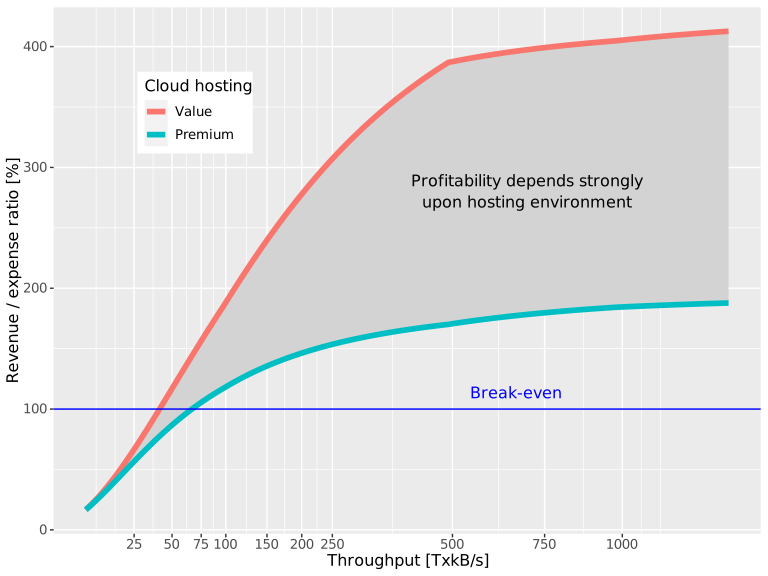
Figure 8: SPO profitability forecast under Leios showing clear economic benefits once sustained throughput exceeds 50-70 TxkB/s (36-50 TPS equivalent)
2. Reasonable time to market: Complexity trade-offs
The research protocol design is optimal in its usage of available network and compute resources. However, it comes at the cost of significantly increased inclusion latency and a high level of concurrency. Both of which are undesirable in a real-world deployment onto the Cardano mainnet and need to be carefully weighed against the throughput increase.
High concurrency allows for higher throughput by doing more transaction processing at the same time. In the published design and otherwise discussed variants concurrency is introduced by allowing agreement on sequences of transactions independently of the Praos block production. This is the case for when endorser blocks would be announced separately from Praos blocks or input blocks be produced on a completely separate schedule. While such protocol designs often result in higher latency due to more rounds, concurrency in itself gives rise to the dedicated problem of conflicting transactions.
While some level of conflicting transactions and the network/compute waste coming with it may be handled by the consensus protocol without giving adversaries an edge, perpetually storing transactions that do not execute (only one of multiple conflicting transactions can be applied), is a significant cost factor. Techniques for minimizing conflicts arising through concurrent block production like sharding, collateralization or sophisticated mempool coordination have massive impacts on the ecosystem and could delay deployment by years.
The proposed variant without concurrency and linearized processing, achieves high enough throughput without changing transaction semantics, deterministic ordering, and predictable finality patterns that existing dApps and infrastructure depend on today.
3. Minimal downstream impact: Ecosystem preservation
Beyond preserving transaction behavior, the design minimizes infrastructure and operational disruption for the existing ecosystem. The proposed protocol still functions as an overlay extending Praos — like the research paper version, allowing SPOs to upgrade progressively without coordinated migrations.
The most obvious approach to increasing throughput while minimizing disruption would be increasing Praos block sizes. However, this naive alternative would create proportionally longer propagation times that violate Praos timing assumptions and lack sufficient scalability for long-term viability. Additionally, Praos blocks larger than approximately 3 MB would pose security risks by increasing the frequency of short forks that adversaries could exploit to compromise the common prefix property and enable attacks such as double-spending. Nonetheless, improved Praos block times would be an improvement also benefiting Leios.
The coupled block production design can be extended towards higher concurrency models, as demonstrated in simulation results. It maintains compatibility with more aggressive scaling approaches including full Leios variants, EB and IB (input block) decoupling, and sharding extensions, ensuring current throughput gains do not preclude 100x+ improvements when chain growth solutions mature and once the ecosystem is ready to tackle the complexity coming with it.
This linearization proposal balances all four priorities. A delivered 30-65x improvement provides substantially more value than the research paper's higher-concurrency variants, which would impose major changes on the ecosystem and take significantly longer to build.
The following evidence section shall provide quantitative support for these trade-offs and validate the protocol's performance under realistic network conditions.
Evidence
This section provides protocol simulation results, feasible protocol parameters with justifications, node-level simulation results, and operating cost analysis that support the design decisions outlined in the rationale.
Performance Metrics
The performance of a protocol like Leios can be characterized in terms of its efficient use of resources, its total use of resources, the probabilities of negative outcomes due to the protocol's design, and the resilience to adverse conditions. Metrics measuring such performance depend upon the selection of protocol parameters, the network topology, and the submission of transactions. The table below summarizes key metrics for evaluating Leios as a protocol and individual scenarios (parameters, network, and load). Estimates for many of these appear in the following section on Simulation Results. Additionally, future implementations of Leios can be assessed in these terms.
| Category | Metric | Measurement |
|---|---|---|
| Efficiency | Spatial efficiency, | Ratio of total transactions size to persistent storage |
| Temporal efficiency, | Time to include transaction on ledger | |
| Network efficiency, | Ratio of total transaction size to node-averaged network usage | |
| Protocol | TX inclusion, | Mean number of slots for a transaction being included in any EB |
| Voting failure, | Probability of failing to collect sufficient votes for a quorum | |
| Resource | Network egress, | Rate of bytes transmitted by a node |
| Disk usage, | Rate of persistent bytes stored by a node | |
| I/O operations, | Mean number of I/O operations per second, where each operation writes a filesystem block of bytes | |
| Mean CPU usage, | Mean virtual CPU cores used by a node | |
| Peak CPU usage, | Maximum virtual CPU cores used by a node over a one-slot window | |
| Resilience | Adversarial stake, | Fractional loss in throughput due to adversarial stake of |
Table 5: Performance Metrics
Spatial efficiency: Leios necessarily imposes some disk overhead beyond the raw bytes needed to store transactions themselves. This overhead includes the EBs and RBs associated with storing transactions. The spatial efficiency metric is defined as the ratio of the total bytes of transactions included in the ledger to the total persistent storage required by the protocol.
Temporal efficiency: As is true for Praos, there is a delay between submitting a transaction and its being included in the ledger and there is a finite chance that it never is included in the ledger. Before a transaction is endorsed, it must be validated and placed in the memory pool. It is cleanest to measure the time from the transaction reaching the local memory pool of the node where it was submitted to the time when it is included in the ledger, via a Praos block. The same metric applies both to Praos and to Leios. In aggregate, we measure the temporal efficiency as the fraction of transactions that reach the ledger, as function of the number of slots elapsed. The quantity is the fraction of submitted transactions that ever reach the ledger.
Network efficiency: Effective utilization of the network can be characterized by the ratio of bytes of transactions reaching the ledger to the average network traffic per node. (This could also be computed individually for each node and used as a local metric.)
TX inclusion: In Leios, it is possible that a transaction might have to wait for multiple EB production opportunities before being included in an EB. The characteristic time for such inclusion in an EB depends on the EB production rate and mempool management. This is correlated with how long the transaction waits in the memory pool before being selected for inclusion.
Voting failure: Under stake-based truncation the committee is deterministic, so quorum failure is not caused by sortition randomness. Instead, a quorum may fail to form if vote-diffusion pressure prevents enough votes from arriving within — for example, when a large committee produces more votes per EB than the network can diffuse in time.
Network egress: Cloud service providers typically charge for network egress rather than for network ingress. The quantity is the number of bytes sent from a node per unit time.
Disk usage: Leios requires that EBs and RBs be stored permanently; votes need not be stored permanently, however. The quantity is the total number of EB and RB bytes generated per unit time.
I/O operations: Some cloud service providers limit or bill input/output operations on a per-second capacity basis. The number of I/O operations depends upon the filesystem's block size , not on the logical number of writes to disk by the protocol: e.g., writing an EB of 32,768 bytes might consist of 64 I/O operations on a filesystem having a 512-byte block size. We assume that disk caching and delayed writes smooth out the unevenness in I/O operations, so that the mean is the best metric here.
Mean CPU usage: Computation resources consumed by the number are quantified as , which is the mean number of virtual CPU cores utilized by the protocol.
Peak CPU usage: Because CPU usage varies depending upon the node's activity, the maximum number of virtual CPU cores utilized by the protocol during any slot, , provides a useful indication of computational burstiness and of how a virtual machine should be sized for Leios.
Adversarial stake: Similarly, when adversarial stake is appreciable and active, the throughput of Leios might drop.
Simulation Results
The Leios paper provides a rigorous theoretical analysis of the safety and throughput of the protocol. That has been reinforced and demonstrated by prototype simulations written in Haskell and Rust.
The simulation results use a mainnet-like topology that
accurately reflects the characteristics of the Cardano mainnet. This includes a
realistic distribution of stake and a representative number of stake pools. The
network is designed with a total of 10,000 nodes
pseudo-mainnet or 750 nodes mini-mainnet,
where each block producer is connected exclusively to two dedicated relays.
Furthermore, the topology incorporates realistic latencies based on the RIPE
Atlas ping dataset and bandwidth that aligns with the lower end of
what is typically found in cloud data centers. The node connectivity and
geographic distribution (across various countries and autonomous systems) are
also consistent with real-world measurements. A simulation
study has demonstrated that analysis conclusions deriving
from the mini-mainnet topology are also valid for the pseudo-mainnet
topology; the advantage of using the former is that simulations run much more
quickly. Simulated RB diffusion is consistent with the Praos performance
model.2 For instructions on how to recreate these simulation results,
see 3.
The simulation results in the remainder of this section use the Rust simulator with a set of protocol parameters suitable for running Leios at 200 kB/s of transactions, which corresponds to approximately 150 tx/s of transactions of sizes typical on the Cardano mainnet. The maximum size of transactions referenced by an EB is 12 MB and the stage lengths are , , and . In order to illustrate the minimal infrastructure resources used by Leios at these throughputs, we have limited nodes to 4 virtual CPUs each and limited inter-node bandwidth to 10 Mb/s. We vary the throughput to illustrate the protocol's behavior in light vs congested transaction loads, and inject transaction from the 60th through 960th slots of the simulation; the simulation continues until the 1500th slot, so that the effects of clearing the memory pool are apparent.
The simulation is based on the "stake-based truncation" committee selection
algorithm (known as 'top-stake-fraction' in the simulator configuration). With
the stake distribution in the mini-mainnet topology this results in a
committee size of 208, less than the ideal size. We therefore also ran it with a
1500 midi-mainnet, derived similarly, which produces a committee size of 448 —
both lower than the seats recommended in Table 7. An
'everyone votes' mode was run on both topologies to bracket the recommendation
from above, at 750 and 1500 voters per EB respectively. The results of all these
tests are documented in the 2026w18 analysis.
The table below summarizes the results of the simulation experiment. We see that a transaction at the front of the memory pool can become referenced by an EB in as few as 13 seconds when the system is lightly or moderately loaded and that it can reach certification on the ledger in well under a minute. These times almost triple under congested conditions. In all cases there is little overhead, relative to the total bytes of transactions, in data that must be stored permanently as the ledger history.
| Throughput [TxMB/s] | TPS at 1500 B/tx | Conditions | Mempool to EB [s] | Mempool to ledger [s] | Space efficiency [%] |
|---|---|---|---|---|---|
| 0.150 | 100.0 | light load | 13.2 | 49.2 | 95.1 |
| 0.200 | 133.3 | moderate load | 13.4 | 49.5 | 95.6 |
| 0.250 | 166.7 | heavy load | 21.5 | 61.3 | 95.4 |
| 0.300 | 200.0 | congestion | 38.2 | 76.4 | 95.8 |
| 0.350 | 233.3 | over capacity | 95.4 | 134.2 | 95.7 |
Table 6: Leios efficiency at different throughputs
The first plot below demonstrates that most transactions reach the ledger in under two minutes in these simulations when the system is not congested. This transaction lifecycle time lengthens as congestion increases. The plot colors transactions by the minute when they were submitted so that one can see that the distribution of delays is independent of the submission time in the uncongested cases, but that there are "lucky" or "unlucky" periods in the congested cases. The variability arises from the randomness of the RB production scheduled. First, a transaction may has to wait for an RB to be forged; second, a transaction referenced by an EB has to wait for the following RB to be forged. The EB is discarded, however, if the second RB is produced in fewer than after the first RB. Thus, both the time to the next RB and the RB following that introduce unpredictability in a transaction reaching the ledger under even lightly loaded conditions. When the sortition happens to produce RBs too close together, transactions will accumulate in the memory pool, awaiting favorable sortition conditions. If too many accumulate, there is not room for all of them to be included in the next EB. The second plot below illustrates that all transactions eventually do arrive on the ledger, but that they may have to wait long during congestion. During light load a transaction takes one or two minutes to reach the ledger, but in heavier load it might take three minutes or even longer. The capacity parameter (12 MB/EB in these simulations) fundamentally limits the amortized maximum throughput of Leios: furthermore, it affects how long it takes transactions to reach the ledger as the throughput approaches the capacity. Note that 300 TxkB/s is just below the theoretical limit of throughput for the protocol parameters used in the simulation; at that rate, runs of unlucky sortition will delay some transactions reaching the ledger, even though those transactions eventually do reach it when sortition becomes luckier. At 350 TxkB/s, transactions will backup up in the memory pool and clients, taking longer and longer to reach the ledger: the bottom row of the first plot illustrates that when transactions stop being submitted in the 16th minute of the simulation, those queued up in the memory pool and clients do eventually reach the ledger, as expected for a protocol exhibiting "backpressure" on clients when load exceeds capacity. A realistic prototype or an actual Leios node implementation would not exhibit the long delays that one sees in the bottom row of Figure 9, which is an artifact of the simulator having an unbounded memory pool; instead, the times from the memory pool to ledger would exhibit the behavior of the 300 TxkB/s row above it, where the memory pool never gets fuller than can be cleared by one or two successful EBs. (Note that Praos is subject to this same behavior where the larger the memory pool, the longer the delay from the memory pool to ledger, under conditions of demand that exceeds capacity.)
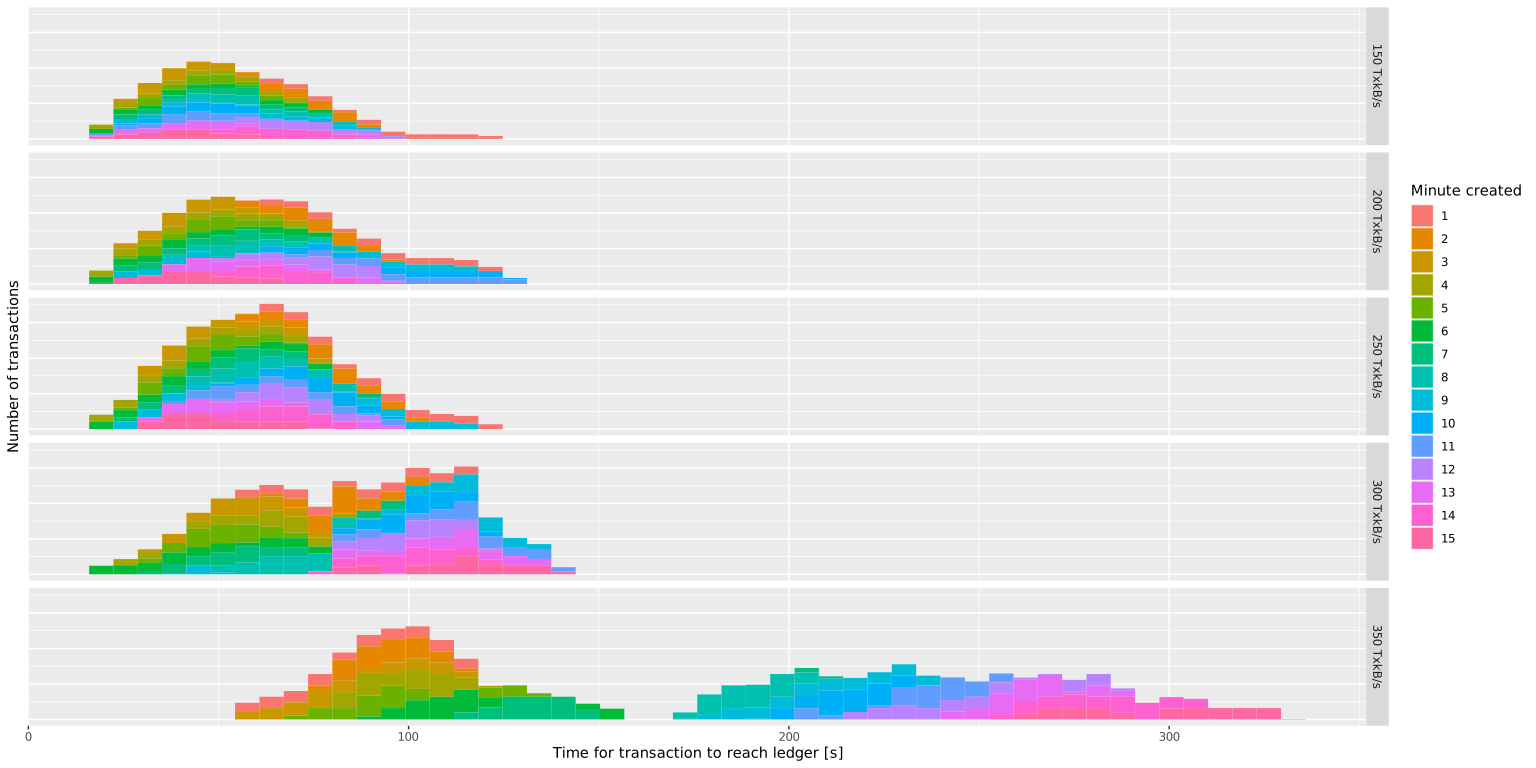
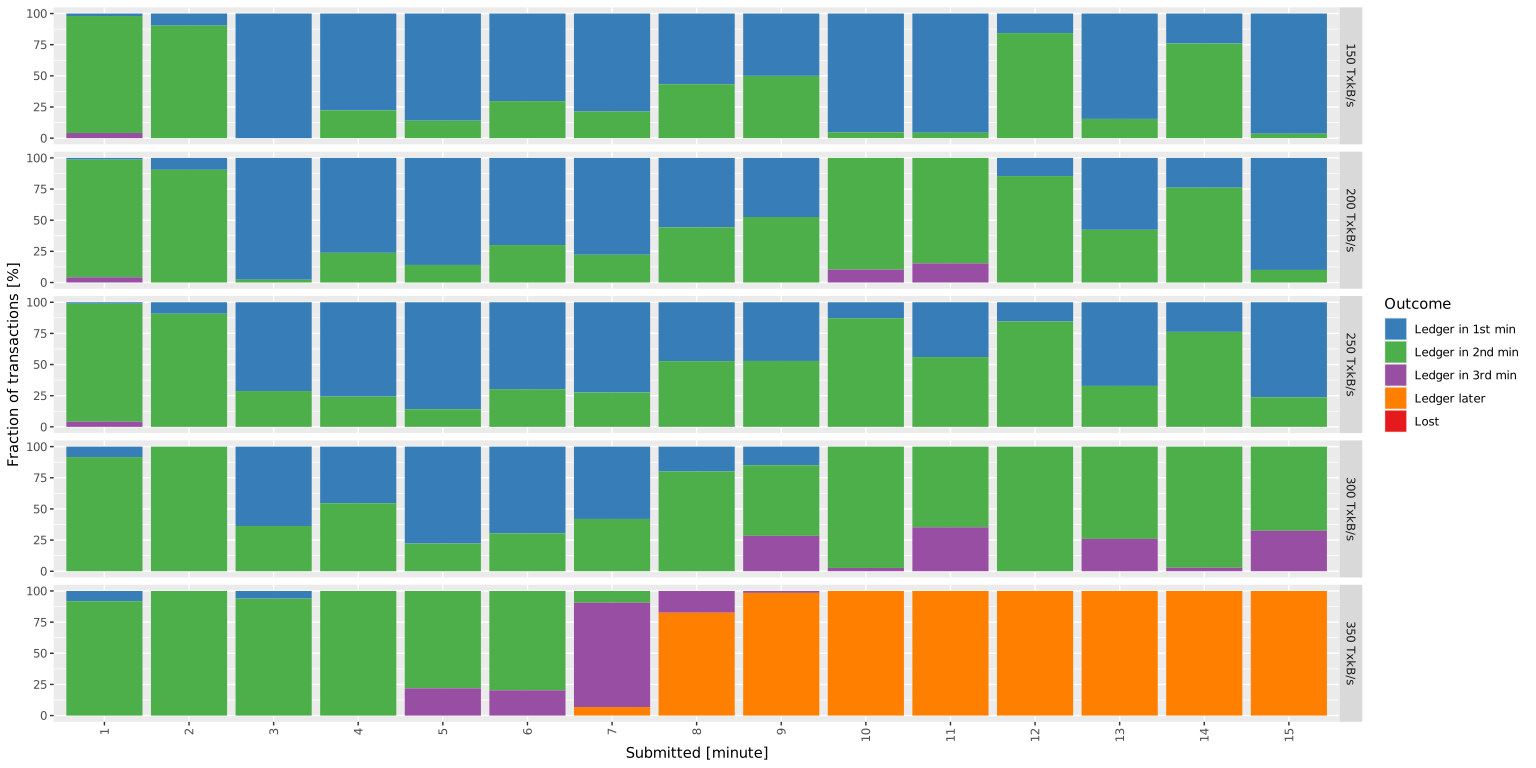
The effect of EBs being discarded when RBs are too close together is evidenced in the following plot. A transaction referenced only once by an EB is one that reaches the ledger on the first attempt. If a transaction is referenced by more than one EB, it means that several attempts were made to before a relevant EB's certificate was included in an RB. The subsequent plot shows Leios' irregular rhythm of forging, sometimes discarding, and certifying EB. (Note that RBs are so small relative to most EBs that they are difficult to see in the histogram.) The diagram also provides a sense of the intermittency of successful certification and the presence of periods of unfavorable sortition where RBs are not produced or are produced too close together. The same phenomenon occurs in Praos, but Leios amplifies the intermittency.
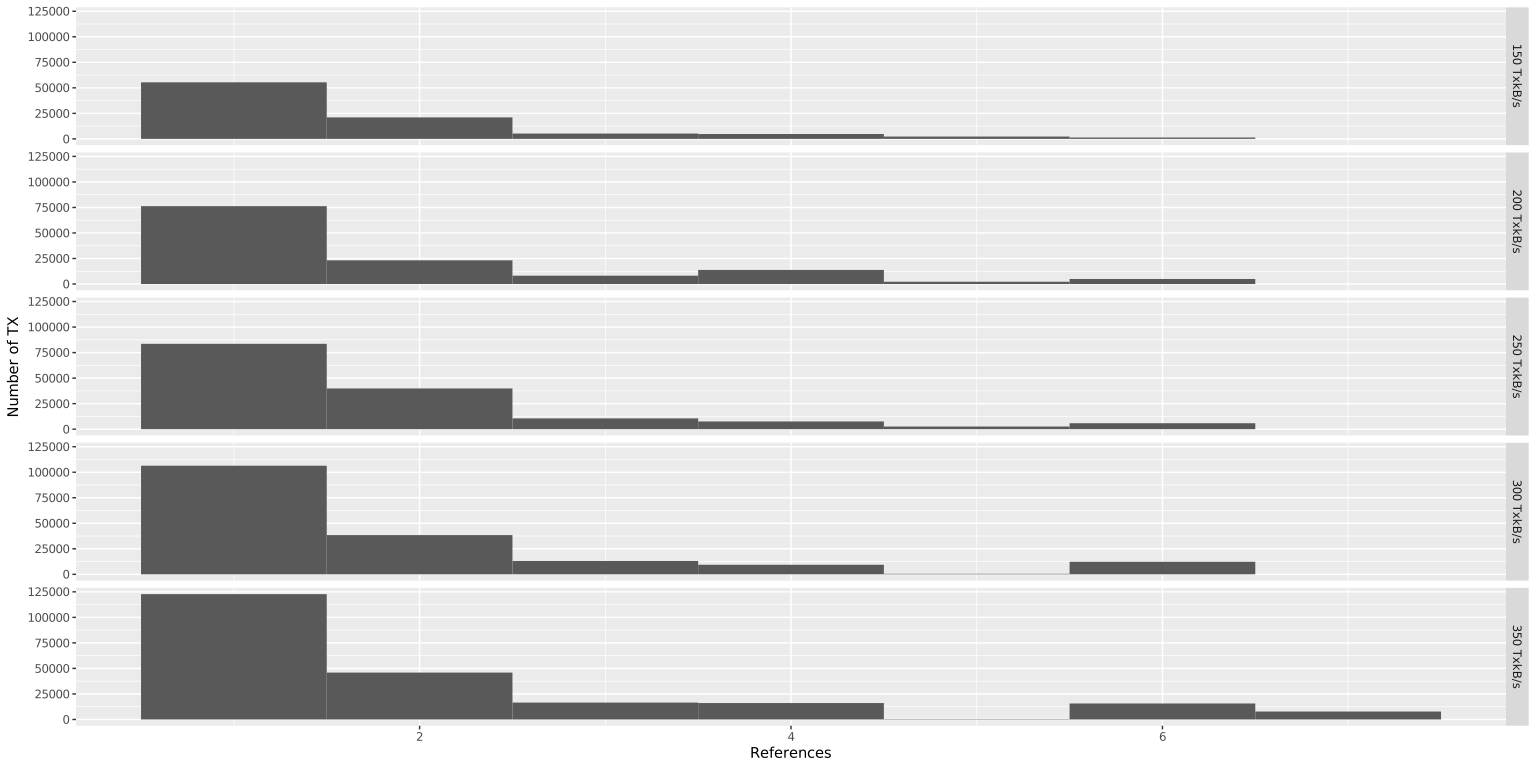
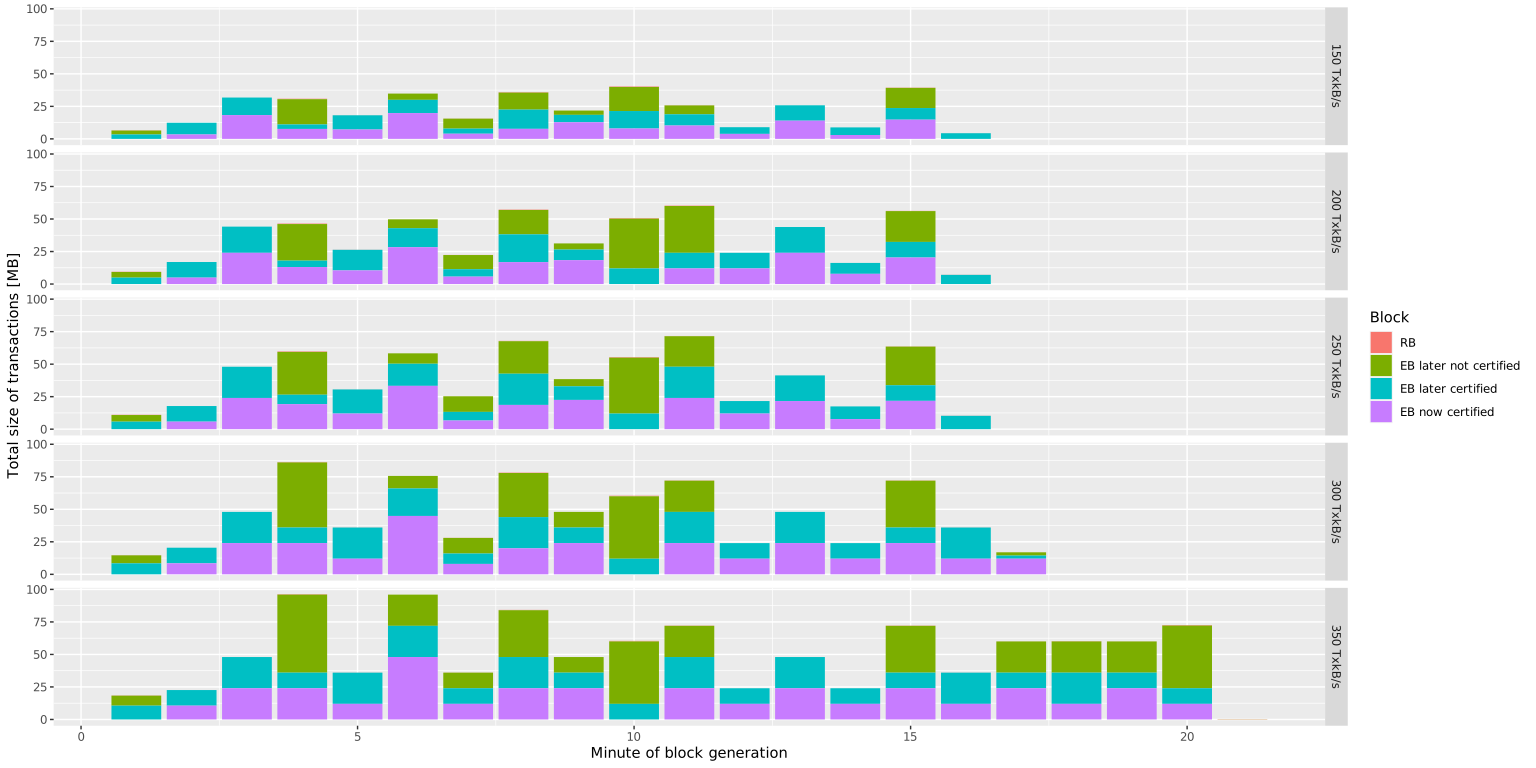
Figure 12: Disposition of transactions in blocks (RBs are so small as not to be visible in the histograms. When an EB is generated, it is labeled in the plot as to whether it will eventually be certified ("EB later certified") or not ("EB later not certified"). When the certificate is included in an RB, the EB is labeled "EB now certified".)
When demand is not high relative to capacity, the total size of transactions referenced by an EB varies randomly and rarely reaches the maximum size of 12 MB/EB: see the following figure. One can see that at higher demands fully utilized blocks predominate. The presence of those full blocks means that other transactions are waiting in the memory pool for referencing by a subsequent EB. Thus the capacity parameter provides a natural form of backpressure that limits the potential EB-related work a node must do when demand is high.
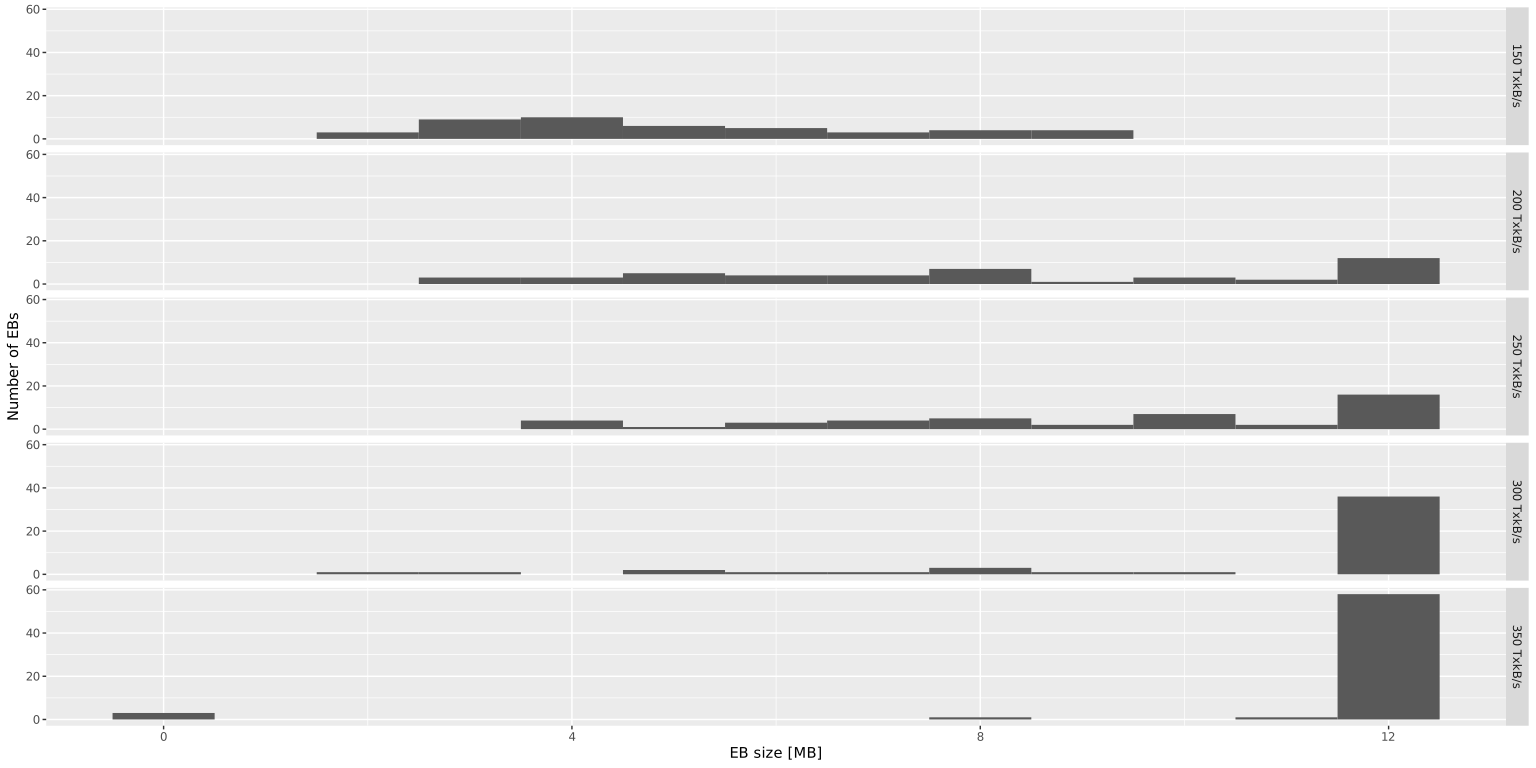
Because of the aforementioned backpressure, diffusion occurs in Leios in an orderly manner even when demand is high. The following set of plots show histograms of diffusion time (i.e., the time from a transaction's, RB's, EB's, or vote's creation to its reaching the nodes in the network). Transactions and votes typically diffuse rapidly throughout the whole network in fractions of a second, due to their small sizes, often small enough to fit in a single TCP transmission unit. RBs diffuse in approximately one second, with the empty RBs at the start and end of the simulation diffusing fastest. Similarly, EBs diffuse fast when empty or when demand is low, but once full EBs are diffusing, it can take up to two seconds for them to diffuse. All of the distributions have long tails where messages arrive much later for nodes with unfavorably topological locations. The Leios protocol possesses the important property that traffic in transactions, RBs, votes, and EBs do not interfere with one another: for example, delays in EBs and high throughput do not also delay RBs in those cases.
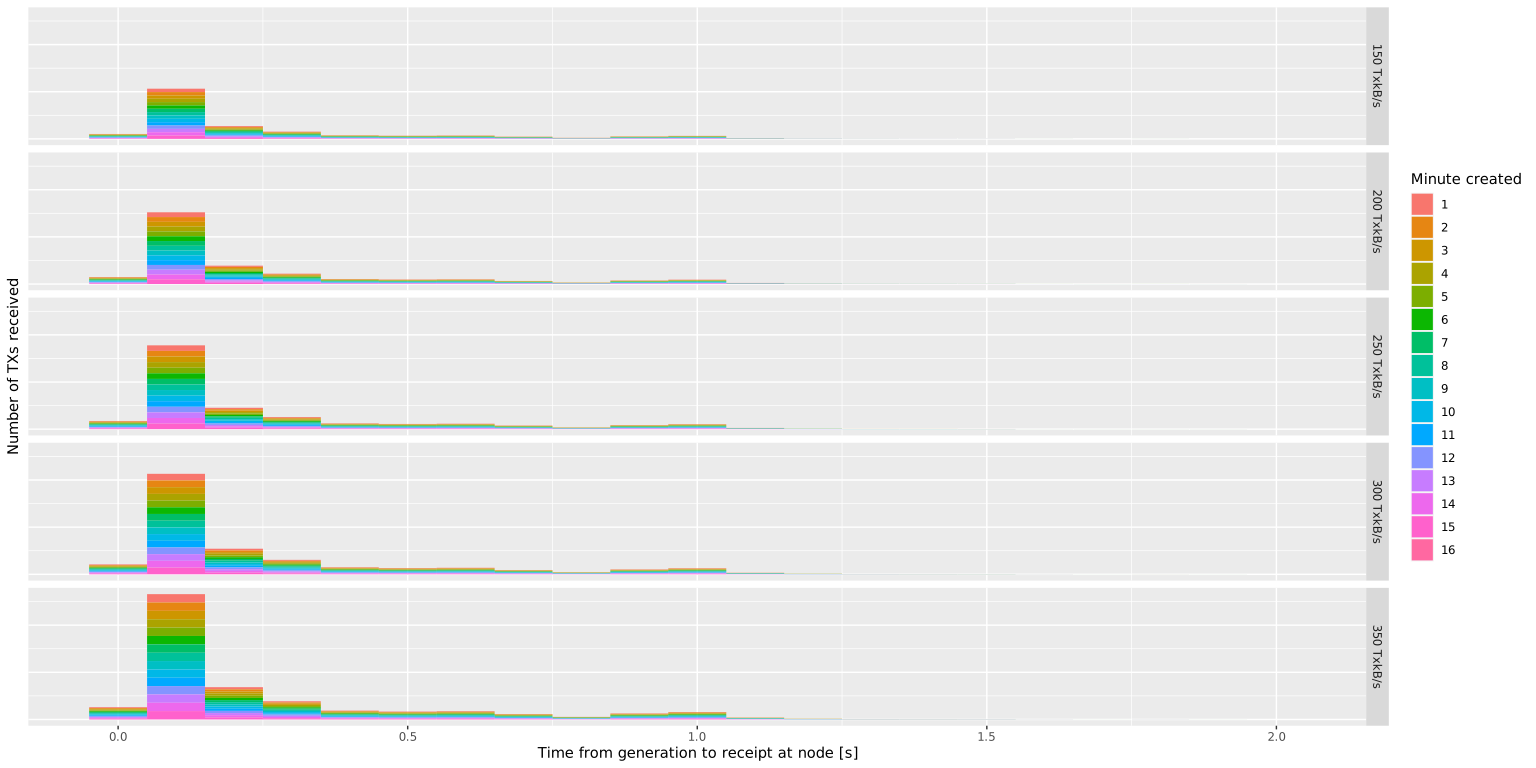 | 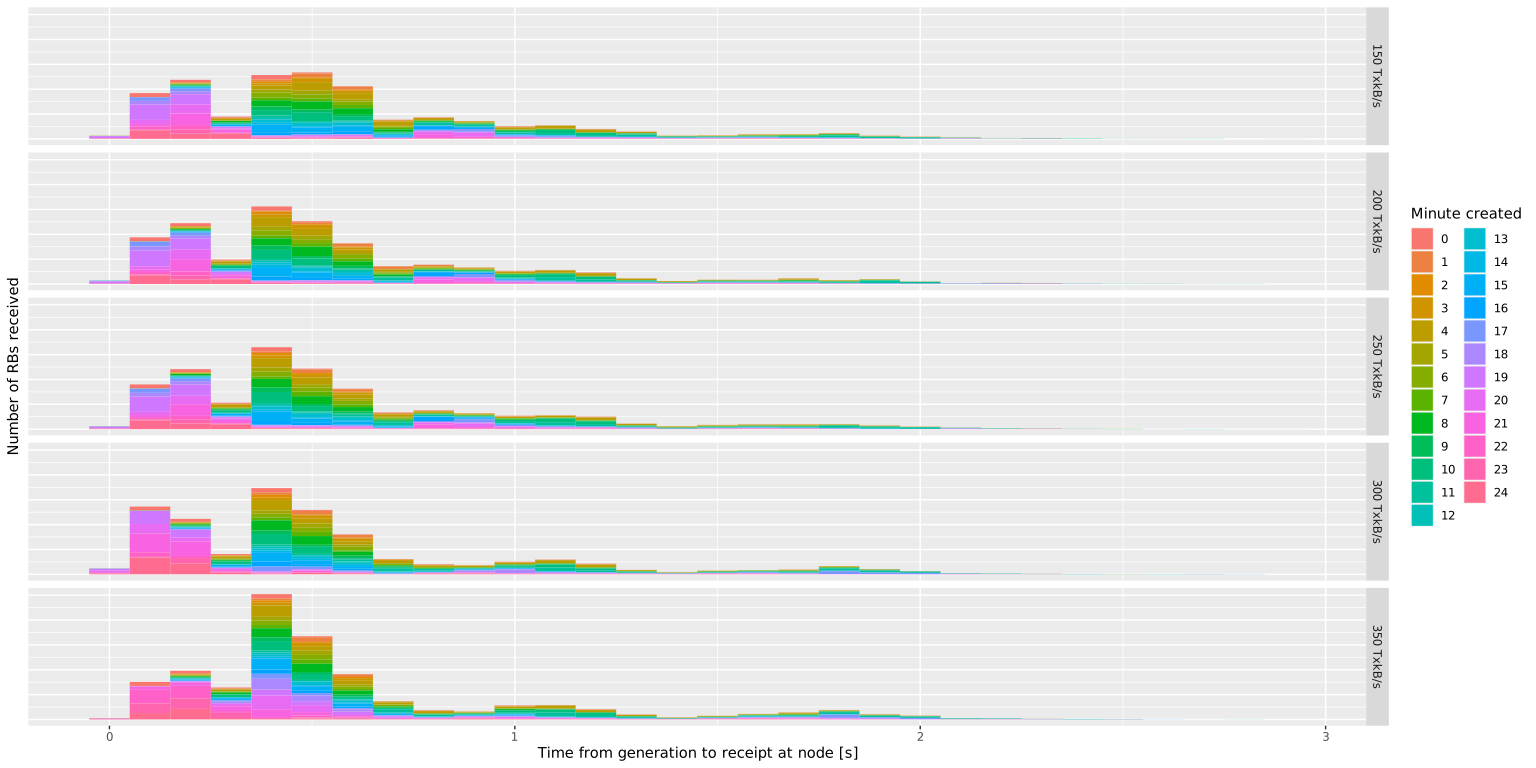 |
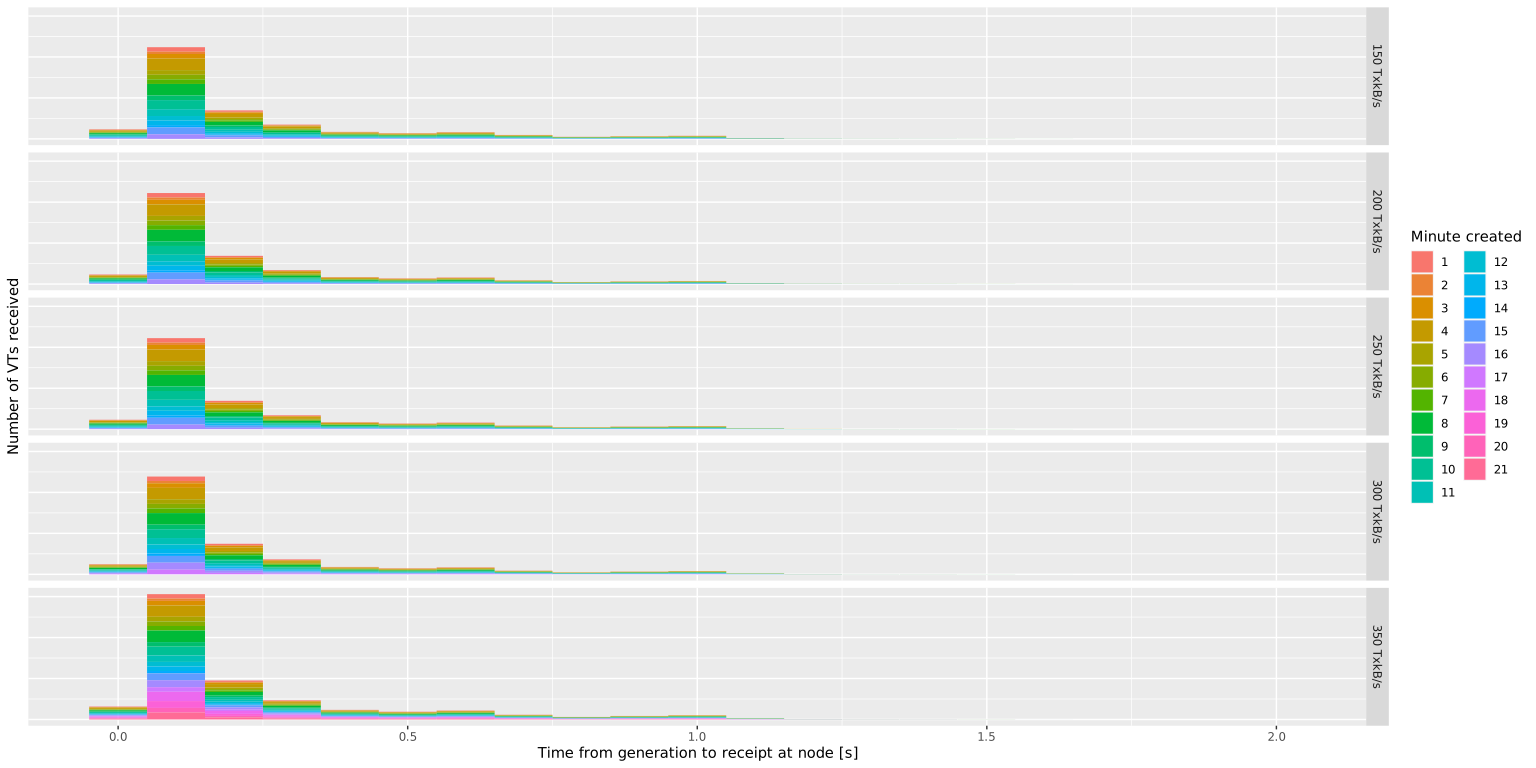 | 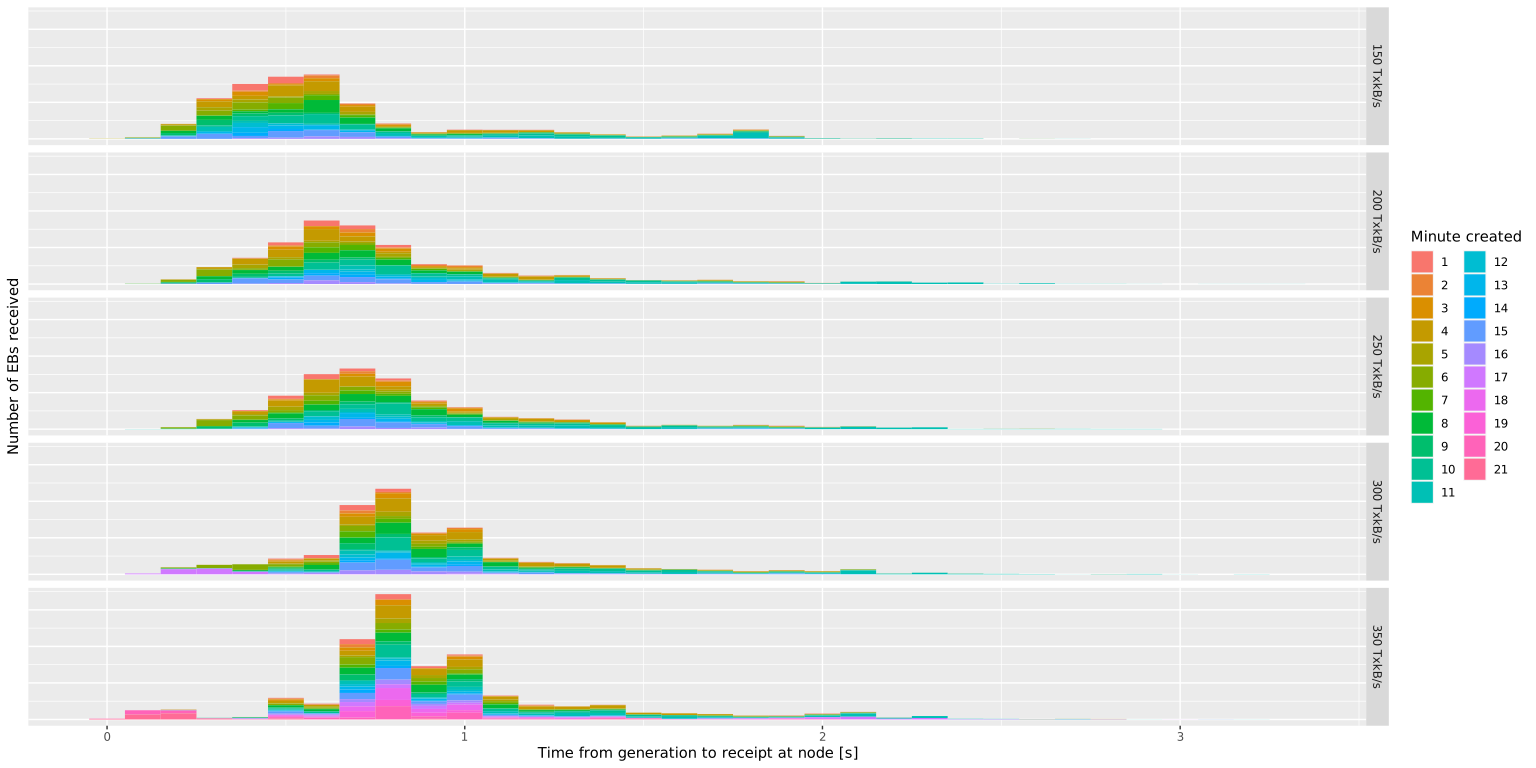 |
Figure 17: Arrival delays for transactions ("TX", upper left), ranking blocks ("RB", upper right), votes ("VT", lower left), and endorser blocks ("EB", lower right)
Behavior under varying load
The simulation results also provide evidence that Leios operates as a well-behaved protocol, conforming to three specific desirable properties.
- Throughput is proportional to load until it plateaus when capacity is reached: Figure 14 illustrates the near equality of throughput to load up until the approximately 300 TxkB/s capacity (determined by the protocol parameters) is reached, beyond which throughput stays constant. (Note that the randomness of sortition and the finite duration of the simulation results in some jitter and uncertainty in the data points even though the trend is clear.) It is particularly important that the throughput does not degrade at very high demand: instead Leios provides backpressure on clients, via the memory pool, so that the protocol operates at capacity even though demand is higher.
- Transaction delivery time and its variance remains constant up until the protocol's capacity is reached: The left side of Figure 15 demonstrates that the observed range of transaction delivery time, which is defined in these plots as the time from being submitted to the time of reaching the ledger, stays essentially constant nearly until capacity is reached. Because the Leios simulator has an unbounded (unlimited) memory pool, one sees that times increase beyond that due to the memory pool growing ever larger. Near capacity, fluctuations from sortitition result in uncertainty. The right side of Figure 15 shows the additional time imposed by Leios relative to Praos: at very low demand, Leios does not often forge EBs and the delay is small, but at moderate and high loads a nearly constant delay is associated with most transactions appearing in EBs. This property is important in that Leios performance does not degrate as demand approaches or exceeds capacity.
- The processing cost per transaction decreases or levels off as load increases: Figure 16 evidences that the CPU and network used per transaction generally drops as load (i.e., demand) increases. (Once again there are uncertainties in this plot due to the randomness or sortition and design choices in the Leios simulator.) This property is important in that the per-transaction consumption of resources should not lower efficiency, which would lead to disproportional stress on resources as load increases.
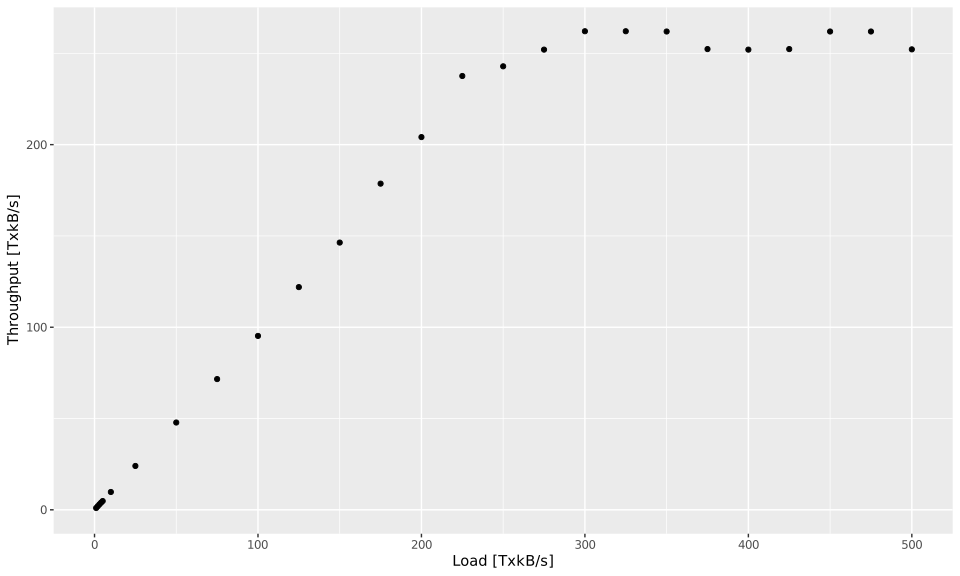
Figure 14: Leios throughput (bytes reaching the ledger) as a function of load (i.e., demand). Points are uncertain due to the randomness of block production in these simulations of twenty minutes. Note that the simulator's unlimited memory pool starts empty.
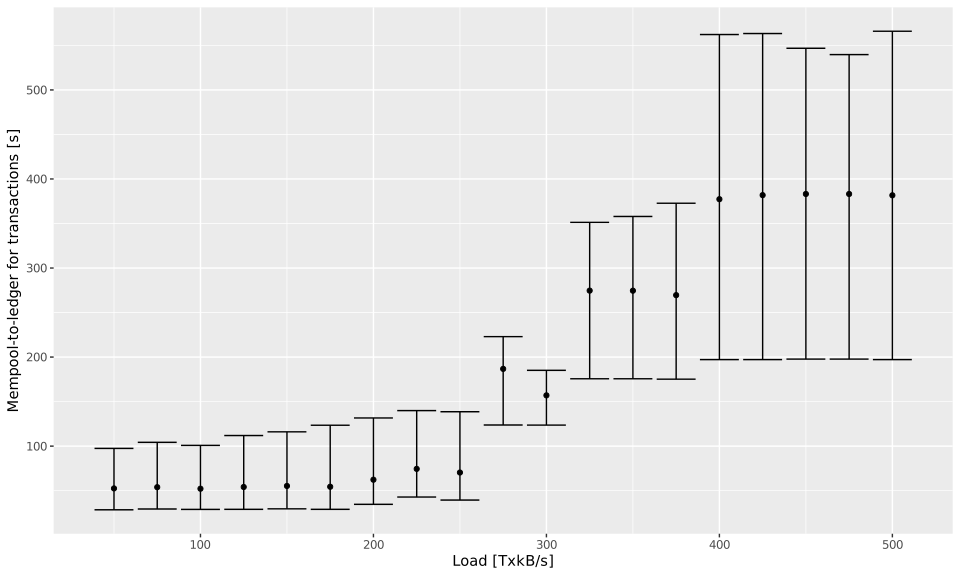 | 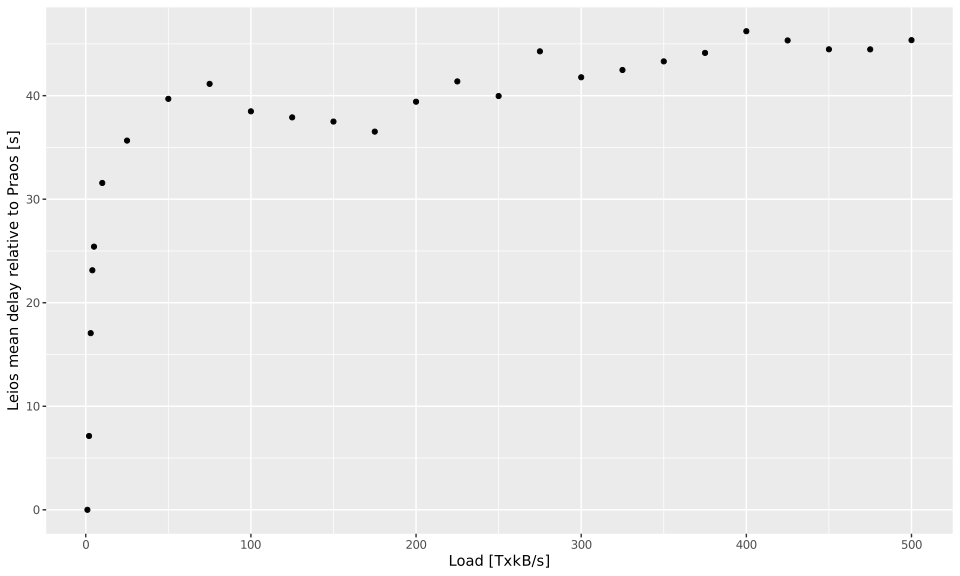 |
Figure 15: (left) time from a transaction's being submitted to the memory pool to its reaching the ledger (10th, 50th, and 90th percentiles) as a function of load; (right) Additional time it takes a transaction to reach the ledger in Leios, relative to the time it would have taken in Praos, as a function of demand. Points are uncertain due to the randomness of block production in these simulations of twenty minutes. Note that the simulator's unlimited memory pool starts empty.
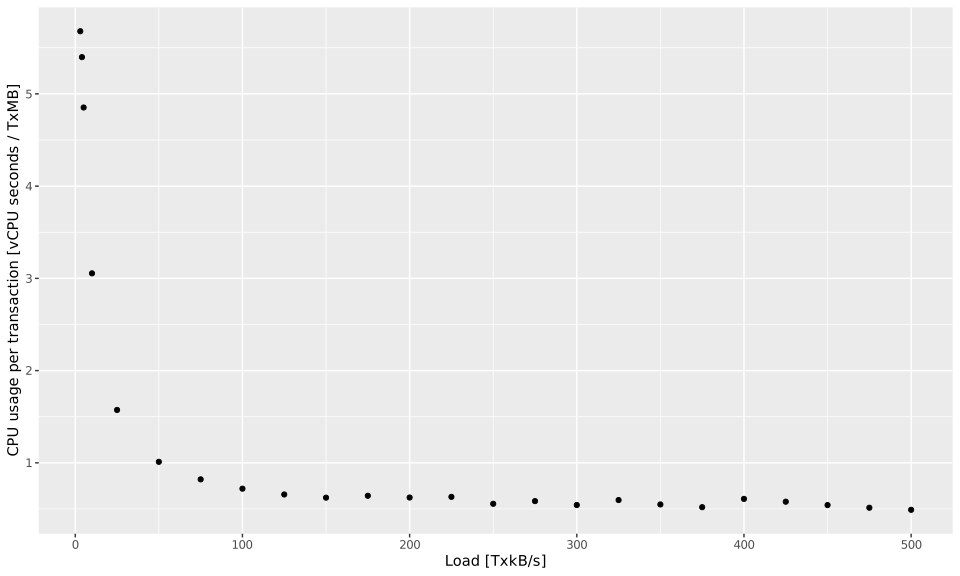 | 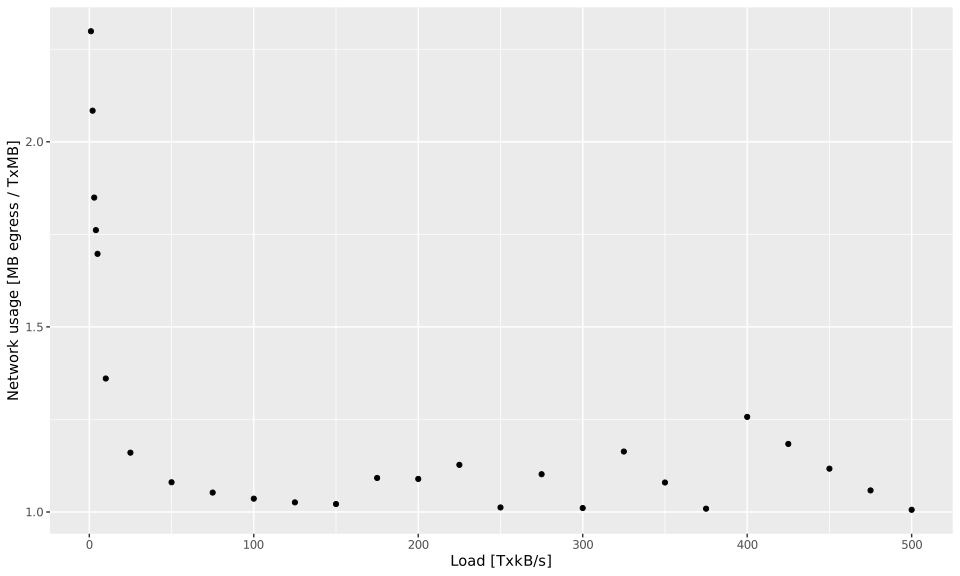 |
Figure 16: The resource cost of Leios processing per transaction as a function of load (i.e., demand): (left) CPU usage; (right) network egress. Points are uncertain due to the randomness of block production in these simulations of twenty minutes. Note that the simulator's unlimited memory pool starts empty.
Resource requirements
The resource requirements for operating Leios nodes have been estimated from
benchmarking and simulation studies. The assumed values for various Leios
operations come either from measurements of the cryptography
prototype, from the IOG benchmarking cluster for the Cardano node,
or analysis of the Cardano mainnet ledger using the db-analyser tool. These
were input to the Haskell and Rust simulators for Leios to make holistic
estimates of resource usage of operating nodes.
In terms of resource usage, the throughputs in these simulations do no stress the four virtual CPUs of each node or saturate the 10 Mb/s available bandwidth between nodes. The figures below show that bandwidth usage does not exceed 4 Mb/s and that most of that is consumed by diffusion of transactions among the nodes. Furthermore, vCPU usage stays below 100% (i.e., the equivalent of one vCPU operating fully), though it is very bursty because of the uneven workload of cryptographic and ledger operations. The last figure quantifies how transaction and EB body validation dominate CPU usage. Averaged over time, CPU usage is low: there may be opportunities in the implementation of the Leios node for lazy computations, caching, etc. that will spread out the occasional spikes in CPU usage over time.
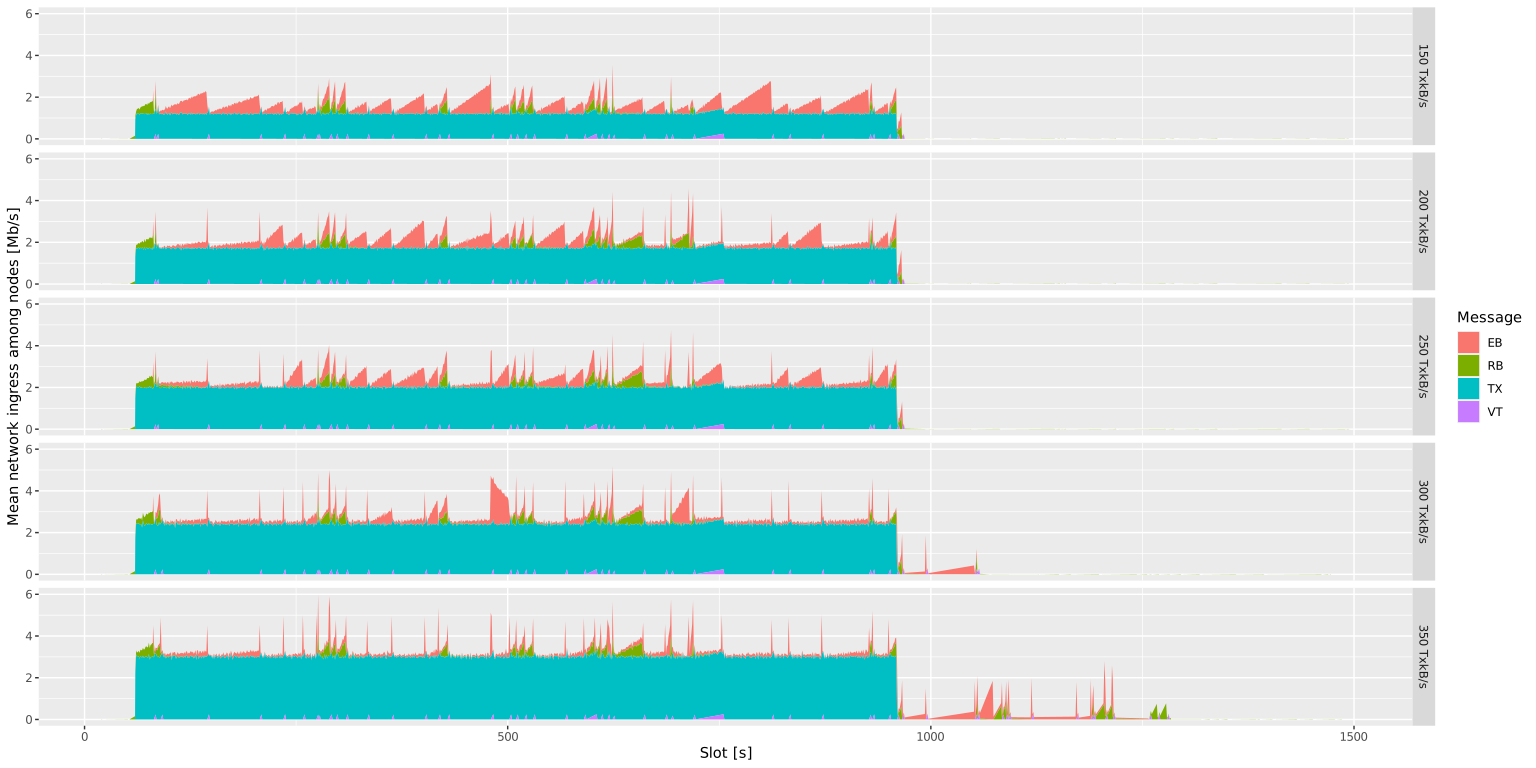
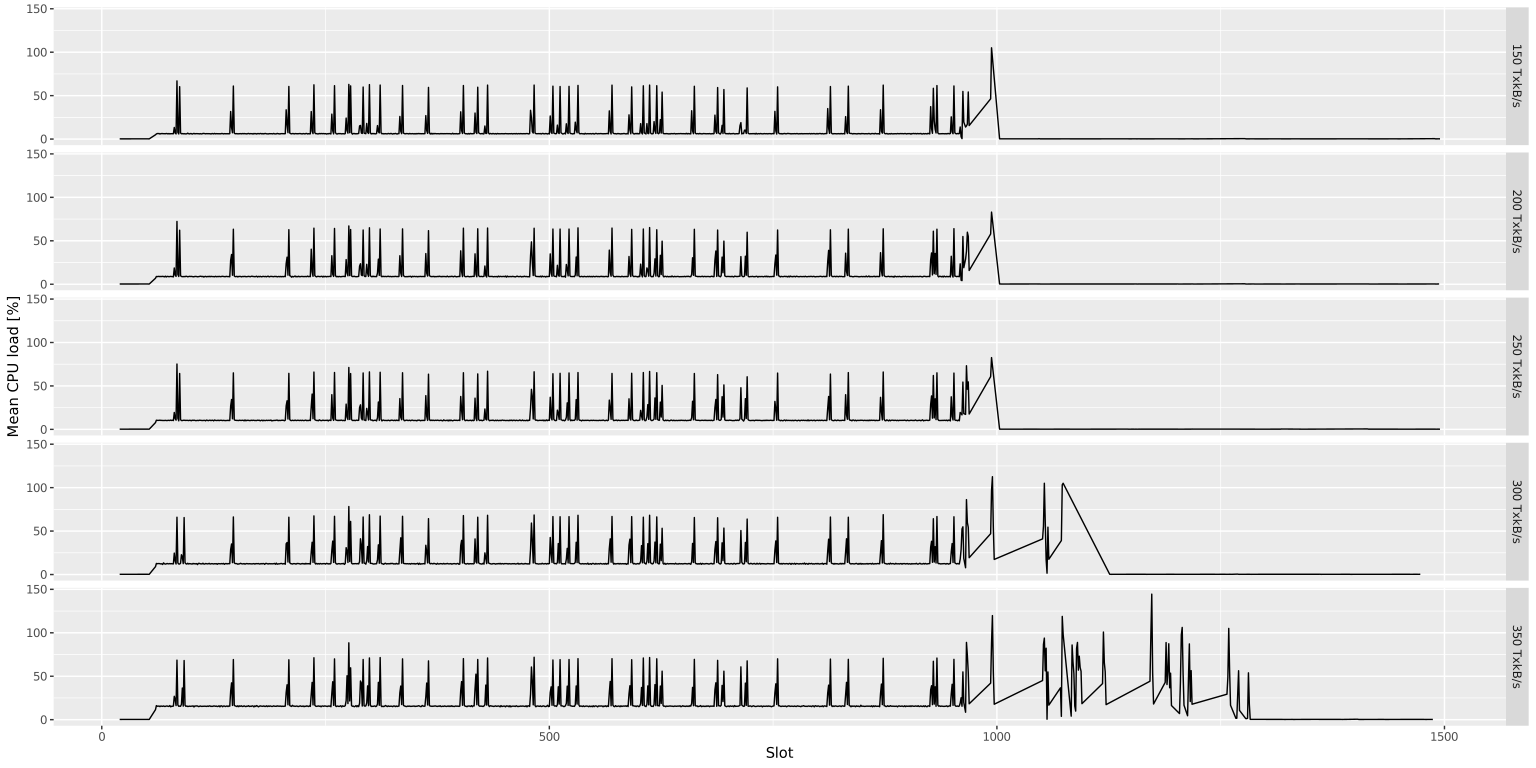
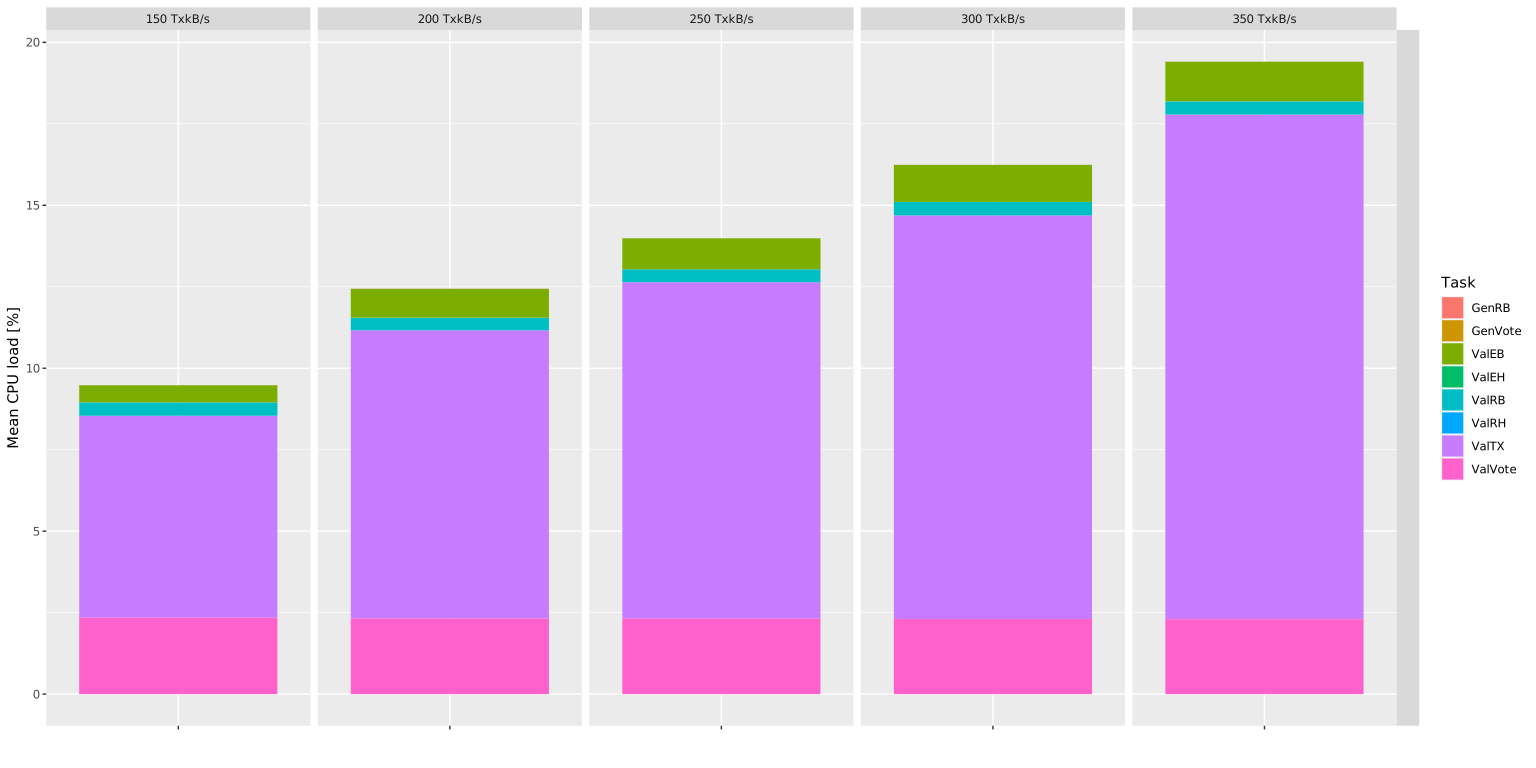
Figure 19: Mean CPU load among all nodes ("Gen" = generated, "Val" = validated, "RH" = ranking block header, "RB" = ranking block body, "EH" = endorser block header, "EB" = endorser block body", "TX" = transaction)
Note that the transaction workload in the simulations above was modeled upon the average amount of Plutus computation typical of the Cardano mainnet. The low time-averaged CPU usage in the simulations (i.e., less than 15% of a vCPU) suggests that the per-transaction and/or per-block Plutus budget could be significantly increased under Leios: either every transaction could have a modestly higher budget, or some transactions could use an order of magnitude more Plutus execution units.
Statistical analysis of CPU usage in ledger operations using the db-analyser tool on Cardano mainnet from epoch 350 through 573 yields the following simple models of the CPU cost of validating signatures and executing Plutus in the transactions of a block. Because of the noisiness in the raw mainnet data, these estimates are uncertain.
- Ledger "apply" operation, consisting of phase 1 & 2 validation along with
updating the current ledger state:
- CPU per transaction in a block:
620.1 μs/tx. - Linear model that accounts for Plutus:
(262.4 μs/tx) * (number of transactions) + (948.7 μs/Gstep) * (billions of Plutus execution steps).
- CPU per transaction in a block:
- Ledger "reapply" operation, consisting of updating the current ledger state,
omitting previously performed phase 1 & 2 validation:
- Linear model:
(353.9 μs) + (21.51 μs/kB) * (size of the block) - Linear model that accounts for Plutus:
(347.8 μs) + (19.43 μs/kB) * (size of the block) + (21.27 μs/Gstep) * (billions of Plutus execution steps)
- Linear model:
The Leios simulators perform the "apply" operation when a transaction is first seen, either when it is received for the memory pool or when it is fetched after first being seen in an RB or EB; they perform the "reapply" operation when a block is being generated or validated. A more nuanced model of CPU usage in the simulators would account for Plutus execution explicitly, but the linear models described above are used to account for Plutus workloads implicitly. The following plot of simulation results limit each node to 4 vCPU cores and suggest that workloads of 1013 Plutus execution steps per EB may be feasible: this is 500 times the current Cardano mainnet limit of 2×10¹⁰ steps for Praos blocks. The subsequent plot shows the 4 vCPUs becoming progressively more saturated with heavier Plutus execution. Although these results suggest that Leios's block-level Plutus budget can safely be 2000 billion steps, it is important to remember that this is for conditions where honest nodes faithfully and promptly diffuse the transactions requiring the relatively expensive phase 2 (Plutus) validation: adversarial nodes could attempt to delay diffusion of transactions in order to overwhelm honest nodes with the sudden arrival of many heavy Plutus transactions and little time to validate them all before voting upon the newly seen EB. Experiments with prototype Leios nodes will be necessary to more precisely quantify how much the Plutus budget could safely be increased.
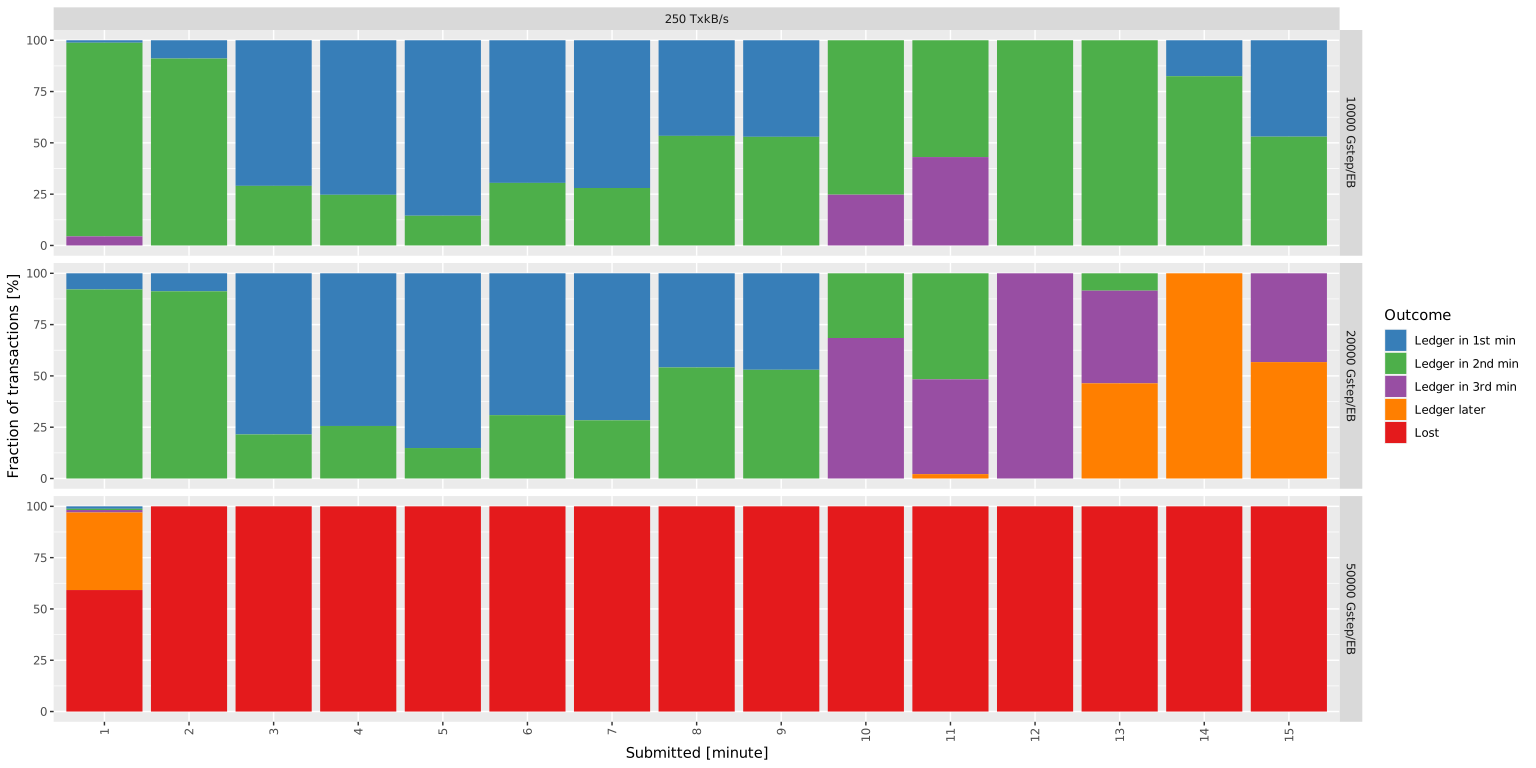
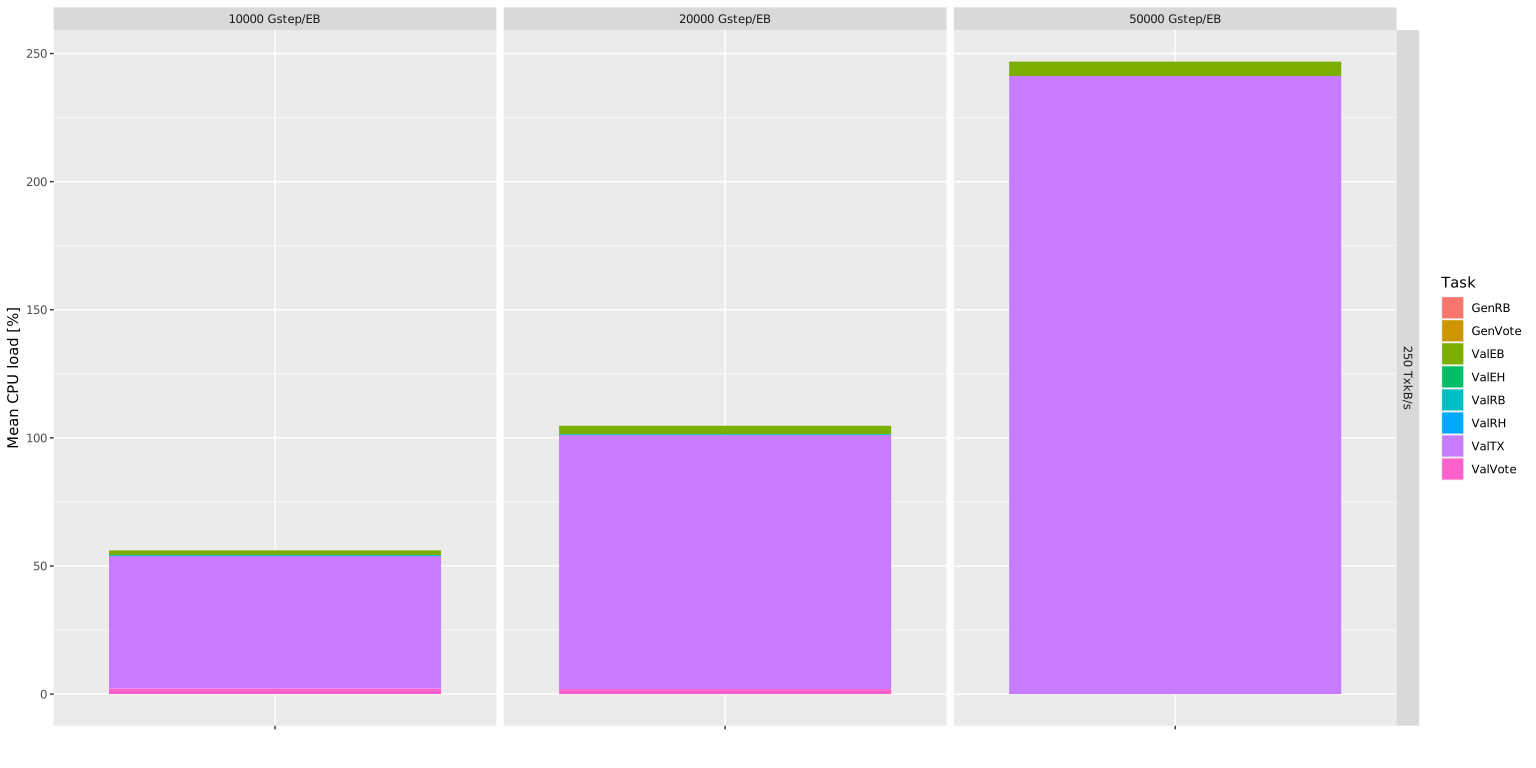
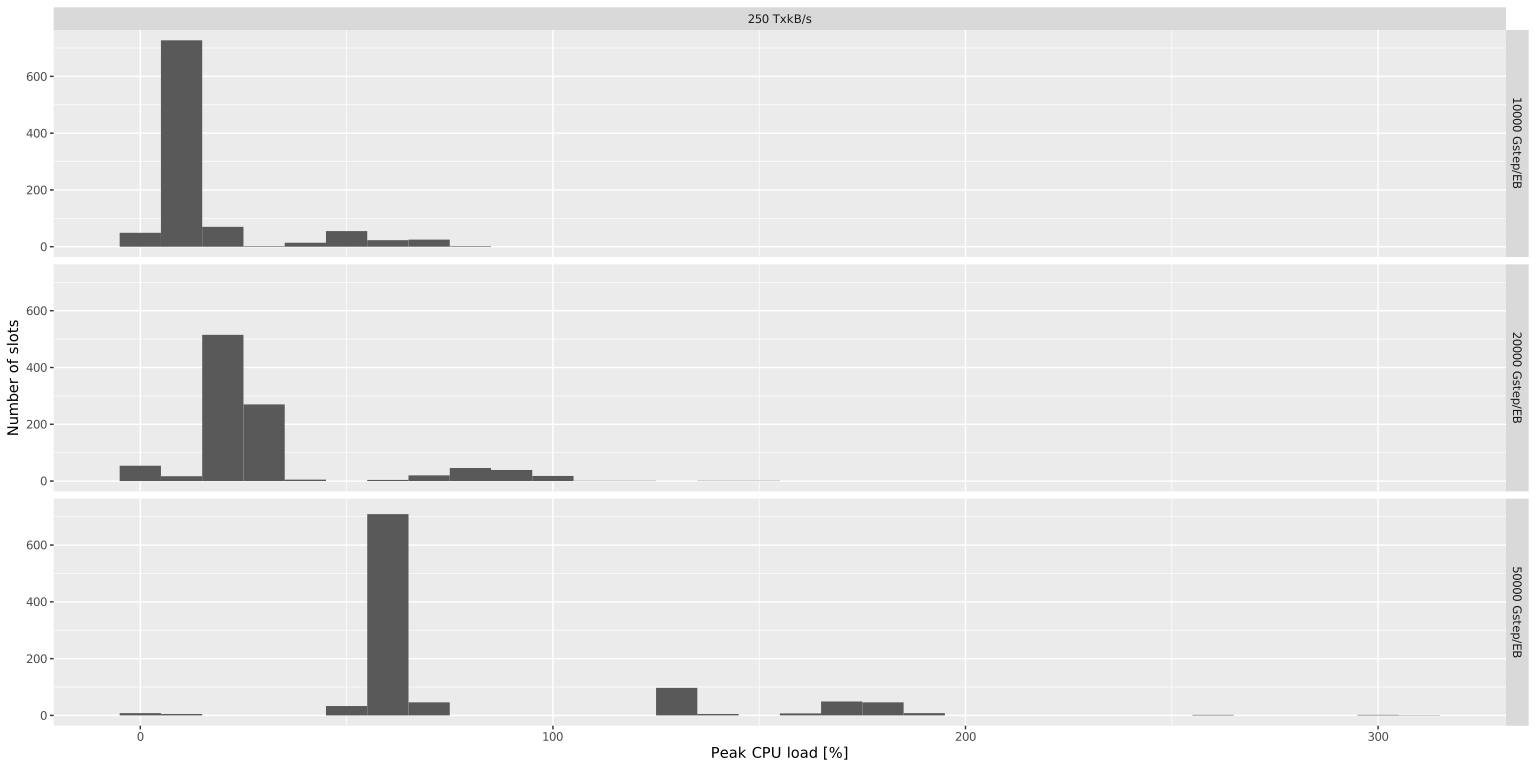
In summary, Leios will require a modest increase of the recommended hardware
requirements: a four-core machine will be required, but a network
upgrade will not be needed, as 10 Mb/s is well below the bandwidth of standard
network connections. At throughput much higher than 200 kB/s, network egress can
become a significant cost for nodes hosted on some cloud-computing providers.
The Leios simulations do not model memory or disk. With the advent of
UTxO-HD, 16 GB of memory will remain be sufficient for Leios if the
OnDisk option is used for the UTxO set. Disk requirements depend upon the
growth of the ledger, but a sustained 0.150 MB/s throughput amounts to ledger
size increasing by 4.7 TB each year: see the section below on
Operating Costs for further discussion.
Feasible Protocol Parameters
Parameter Relationships and Network Assumptions
The key relation in the proposed protocol is between the voting threshold () and propagation delay of EBs (). The high voting threshold ensures that any certified EB is already known to at least of honest stake by the end of — 25% at under the threat model's adversarial stake. This widespread initial knowledge enables the critical network assumption: an EB evidently known to >25% of the network will reach the remaining (online) honest stake within and , so to not impact blockchain safety and liveness. Sustaining that seed fraction is the binding constraint on ; see choosing the quorum threshold.
Example Parameter Calculation
To illustrate how these relationships translate into concrete parameters, consider the following example based on simulated network measurements:
Given Network Characteristics:
Based on the network timing measurements:
- second, seconds - Cardano mainnet assumption for Praos security
- seconds - EB diffusion: transmission + processing
- seconds - EB transmission time for certified EBs
- second - EB reapplication time
Timing Parameter Calibration:
- second: Header diffusion period, where equivocation detection period is seconds (per equivocation detection)
- seconds: Since voting begins after , and EB propagation can occur during equivocation detection, nodes only need 4 additional seconds after for validation plus margin (per voting period)
- seconds: Using the diffusion period constraint with typical values gives minimum of 4 seconds, we use 7 for safety margin
- Total certificate inclusion delay: seconds
With these example values, a certificate may only be included in an RB at least 14 slots after the announcing RB at mainnet's one-second slot length. With Praos' active slot coefficient of , the probability that no RB is produced in the intervening 13 slots is . Even if every RB announces an EB and every timely EB reaches quorum, roughly half of all RBs will therefore carry a transaction list directly rather than a certificate. Not all transactions go through EBs, even under congestion.
Simulation-Tested Parameters
The table below documents protocol parameters that provided high throughput and reasonably fast settlement in prototype Haskell and Rust simulations. The exact choice of parameters for Cardano mainnet must be subject to discussion and consideration of tradeoffs.
| Parameter | Symbol | Feasible value | Justification |
|---|---|---|---|
| Committee size | 900 seats | Covers ~99% of mainnet active stake (890 pools reach 99% at epoch 649), with a 113 B certificate bitfield and a vote count inside the simulated range. See choosing the committee size. | |
| Quorum stake threshold | 0.75 | Votes representing ≥75% of total active stake must sign, so of honest stake holds every certified EB even at 50% adversarial stake — the seed coverage and assume. Must satisfy ; see choosing the quorum threshold. | |
| Header diffusion period length | 1 second | Per equivocation detection: accommodates header propagation for equivocation detection. Equivocation detection period is . | |
| Voting period length | 4 seconds | Per voting period: accommodates EB propagation and validation time, with equivocation detection handled separately by . | |
| Diffusion period length | 7 seconds | Per diffusion period: minimum calculated as 4 seconds with typical network values, use 7 for safety margin. | |
| Maximum endorser block size | 512 kB | Endorser blocks must be small enough to diffuse and be validated within the voting period . | |
| Maximum total transaction size per endorser block | 12 MB | Simulations indicate that 200 kB/s throughput is feasible at this block size. | |
| Maximum reference script size per endorser block | 12 MB | ~11× mainnet's 1 MiB maxRefScriptSizePerBlock in absolute terms, but capped at rather than the ~11.6× of payload Praos permits, since EB validation must finish within . Needs the same simulation grounding as the Plutus budgets below. | |
| Maximum Plutus steps per endorser block | - | 2000G step units | Simulations at high transaction-validation CPU usage, but an even higher limit may be possible. |
| Maximum Plutus memory per endorser block | - | 7000M memory units | Simulations at high transaction-validation CPU usage, but an even higher limit may be possible. |
Table 7: Feasible Protocol Parameters
This design trades a slightly longer total certification time (typically 13-15 seconds) for significant protocol simplification by eliminating complex correction mechanisms and ensuring all RB transactions are always valid.
Simulations on mainnet-like topologies indicate that seven seconds is more than sufficient to diffuse the transactions, blocks, and votes required by Leios. Most nodes receive these in one second or less and even the tardiest nodes receive them in under two seconds. The additional diffusion period provides ample margin for worst-case scenarios while maintaining acceptable latency. Higher-fidelity simulators, better empirical data on mainnet performance, and Leios testnet operations will test the appropriateness of these parameters and refine their values for final recommendations.
The aforementioned simulations also demonstrate that Leios operates up to 0.2 TxMB/s without experiencing congestion, provided endorser blocks reference no more than 12 MB of transactions. Even under adversarial conditions, where malicious nodes release transactions from their private memory pool at the same time that they forge a ranking block and an endorser block, simulations demonstrate that 12 MB of transactions diffuse rapidly enough for the protocol to operate smoothly, achieving a quorum of votes before the voting period ends. It is important to limit the number of transactions referenced by an endorser block because the transaction-execution bitmap in a subsequent ranking block may have to record information about conflicted transactions. A limit of 512 kB on the size of the endorser block itself ensures fast diffusion and limits its contents to 16,000 transactions, since each transaction hash is 32 bytes. That limit keeps the size of the bitmap in the few-kilobyte range, ensuring that it easily fits in the ranking block. The combination of 12 MB of transaction data and 16,000 transactions implies an average transaction size of 2000 bytes when both limits are reached: this is higher than the recent average transaction size on Cardano mainnet.
Estimating the feasible limits for Plutus execution requires a more solid grounding, than currently exists, of the Plutus cost model in terms of actual CPU resources required to execute Plutus steps and memory. The empirical analysis and simulations presented above suggest that the per-block Plutus budget could be substantially increased. Results indicate that 2000 billion Plutus steps would consume less than two CPU-seconds of computation on typical node hardware. On a four-core machine there would be sufficient resources to evaluate the Plutus rapidly enough so as not to interfere with voting for endorser blocks.
Although the Praos maximum block size could be modestly raised in Leios and the active-slot coefficient adjusted slightly, there is no compelling reason to alter these. They could, however, be re-evaluated in the context of the Leios testnet.
The analysis Committee size and quorum requirement in the first Leios Technical Report indicates that the Leios committee size should be no smaller than 500 votes and the quorum should be at least 60% of those votes. Under stake-based truncation, the quorum is expressed directly as a fraction of total active stake (), which is the predicate the security argument actually requires. Certificate size is dominated by a bitfield ( bytes) plus a fixed aggregated signature, so larger committees add negligible on-chain overhead — the practical constraint on committee size shifts from certificate compactness to vote-diffusion traffic within .
Of the two voting parameters, only is safety-critical, and it is bounded from both sides.
From below, by safety. Praos assumes adversarial stake of up to 50%, and an honest pool votes only after receiving and fully validating the EB. Whatever exceeds that assumption, , is therefore honest stake provably holding every certified EB when ends, and it is that remainder which enables the Leios security assumption: it is the coverage the certified EB transmission constraint measures from. Fall short and an adversary can have an EB certified while withholding it from all but a sliver of honest stake, delaying that EB's closure past the bound Praos assumes, which is a Praos safety failure rather than a Leios throughput loss. Below the bound fails outright, since two disjoint sets of voters could each reach a quorum and certify conflicting EBs; a threshold in the 50s clears that only nominally and leaves nothing for the assumption above.
From above, by liveness. Certification needs of total active stake to vote, and only of it is seated, so an adversary that simply declines to vote prevents certification outright with of stake. Raising shrinks that budget one-for-one, and the outside the committee has already spent part of it.
splits these bounds evenly: 25 points above the 50% adversarial stake Praos tolerates, against a ~24 point abstention budget at . It is suggested as a starting value on that basis, to be revisited once operational data narrows either side.
, by contrast, is not safety-critical. It cannot admit a certificate that would reject, because the quorum predicate is evaluated on stake and the certificate proves it; a mis-set only changes which pools may vote, and so whether a quorum can be reached at all. Getting it wrong costs Leios liveness and thus only throughput, never safety, so it can be governed on observed coverage by weighing two factors against each other. Its cost is exact and known in advance: votes on the wire per EB and a -byte bitfield per certificate. Its benefit is the stake it covers, , which fixes the abstention budget : the stake that can decline to vote before no quorum can form. Stake outside the committee, , already counts against reaching , so a smaller committee spends that budget before an adversary has to do anything.
Both factors are read off the prevailing stake distribution. The table below does so for the mainnet active-stake snapshot of epoch 649 (2,680 pools sharing 21.5 B ADA) taken from a chain explorer (Kleioscan stake-distribution analytics). Percentile Pn denotes the smallest committee whose coverage reaches n percent of active stake, so on each row is that percentile.
| Percentile | Seats | Cert bitfield | Note |
|---|---|---|---|
| P50 | 160 | 20 B | Nakamoto coefficient; absolute floor for any valid |
| P75 | 302 | 38 B | Floor at : quorum would require unanimity |
| P90 | 467 | 59 B | 15 points of headroom over |
| P95 | 590 | 74 B | 20 points of headroom |
| P98 | 759 | 95 B | 23 points of headroom |
| P99 | 890 | 112 B | Recommended ceiling; remaining 1,790 pools hold <1% |
| P99.5 | 1,013 | 127 B | +123 seats buys +0.5 points of coverage |
| P100 | 2,680 | 335 B | Every registered pool ("everyone votes") |
Table 7a: Seats needed to reach each stake percentile, and what they cost (mainnet epoch 649)
Two bounds fall out of this:
- Floor. must exceed , or the abstention budget is negative and no quorum can form at all. Today that is the percentile, P75 ≈ 302 seats, and since is itself required the floor never falls below P50, the 160 seats of the Nakamoto coefficient. This is a hard floor rather than an operating point: at exactly every seated pool must vote and be reachable within , so a practical choice leaves budget for pools that are offline, keyless, or slow.
- Ceiling. Beyond P99 the distribution has nothing left to give: 1,790 of 2,680 pools together hold under 1% of active stake, so each further seat buys a vanishing amount of budget for a full extra vote per EB on the wire.
in Table 7 rounds up the P99 ceiling, buying an abstention budget of ~24 points at . It also stays inside the range vote diffusion has been simulated on mainnet-like topologies at, up to 1,500 voters per EB (see the caveat in Design Decisions). Coverage drifts slowly enough that the choice rarely needs revisiting: 99% coverage implied ~916 pools at epoch 612 against 890 at epoch 649.
Approximate Leios operating costs are estimated based on the detailed cost analysis of Leios deployment in Leios node operating costs, the simulation results, and the hardware recommendation for Leios. However, these costs depend on the specific choice of cloud provider hardware and the current market conditions. The estimates below were made in April 2025 for the median pricing of ten common hyperscale and discount cloud providers. The cost of a 10,000-node Leios network can be computed from the cost per node. Storage costs increase each month as the ledger becomes larger.
| Throughput | Average-size transactions | Small transactions | Per-node operation | Per-node storage ($) | Per-node storage (GB) | 10k-node network (first year) | 10k-node network (first year) |
|---|---|---|---|---|---|---|---|
| 150 TxkB/s | 100 Tx/s | 500 Tx/s | $119.01/month | $26.35/month² | 394 GB/month | $15.9M | $217k/epoch |
| 200 TxkB/s | 133 Tx/s | 667 Tx/s | $127.60/month | $37.64/month² | 526 GB/month | $17.6M | $241k/epoch |
| 250 TxkB/s | 167 Tx/s | 833 Tx/s | $132.24/month | $43.92/month² | 657 GB/month | $18.5M | $253k/epoch |
| 300 TxkB/s | 200 Tx/s | 1000 Tx/s | $138.88/month | $54.64/month² | 788 GB/month | $19.8M | $271k/epoch |
| 350 TxkB/s | 233 Tx/s | 1167 Tx/s | $148.47/month | $65.59/month² | 920 GB/month | $21.8M | $298k/epoch |
Table 8: Operating Costs by Transaction Throughput
Required TPS for Infrastructure Cost Coverage: Using average transaction sizes and fees, we can calculate the required TPS to generate enough fees to cover infrastructure costs. Note that only about 20% of fees currently accrue to SPOs, but the table assumes 100% would accrue to them; to maintain the current 80%-20% split, fives times as much fee would have to be collected compared to what is listed in the table.
| Infrastructure cost | Required ADA @ $0.45/ADA | Required transactions (average size) @ $0.45/ADA | Required transactions (small size) @ $0.45/ADA |
|---|---|---|---|
| $15.9M/year | 483k ADA/epoch | 5.15 Tx/s | 6.71 Tx/s |
| $17.6M/year | 535k ADA/epoch | 5.70 Tx/s | 7.44 Tx/s |
| $18.5M/year | 563k ADA/epoch | 6.00 Tx/s | 7.83 Tx/s |
| $19.8M/year | 603k ADA/epoch | 6.43 Tx/s | 8.39 Tx/s |
| $21.8M/year | 622k ADA/epoch | 7.06 Tx/s | 9.21 Tx/s |
Table 9: Required TPS for Infrastructure Cost Coverage
Required TPS for Current Reward Maintenance: To maintain current reward levels (~48 million ADA monthly) through transaction fees as the Reserve depletes.
| Year | Reserve Depletion | Rewards from Fees (ADA) | Required TPS (Average size) | Required Throughput |
|---|---|---|---|---|
| 2025 | ~0% | 0 | 0 | 0 TxkB/s |
| 2026 | ~13% | 6,240,000 | 10.9 | 15 TxkB/s |
| 2027 | ~24% | 11,520,000 | 20.1 | 28 TxkB/s |
| 2028 | ~34% | 16,320,000 | 28.5 | 40 TxkB/s |
| 2029 | ~43% | 20,640,000 | 36.1 | 51 TxkB/s |
| 2030 | ~50% | 24,000,000 | 41.9 | 59 TxkB/s |
Table 10: Required TPS for Current Reward Maintenance
Note that by 2029, to compensate for Reserve depletion, the network would need to process approximately 36 TPS with average-sized transactions, requiring a transaction throughput of around 51 TxkB/s, roughly 20 times the current mainnet throughput. Leios' design would comfortably support this increased throughput while maintaining decentralization.
While the empirical evidence demonstrates Leios' performance capabilities, any protocol modification introduces new attack vectors and operational constraints that must be carefully assessed. The following section examines potential security risks and practical constraints that inform deployment considerations.
Trade-offs & Limitations
High-throughput blockchain protocols require fundamental trade-offs between throughput, latency, complexity, and security. The proposed specification balances these competing dimensions to achieve substantial throughput gains while preserving ecosystem compatibility.
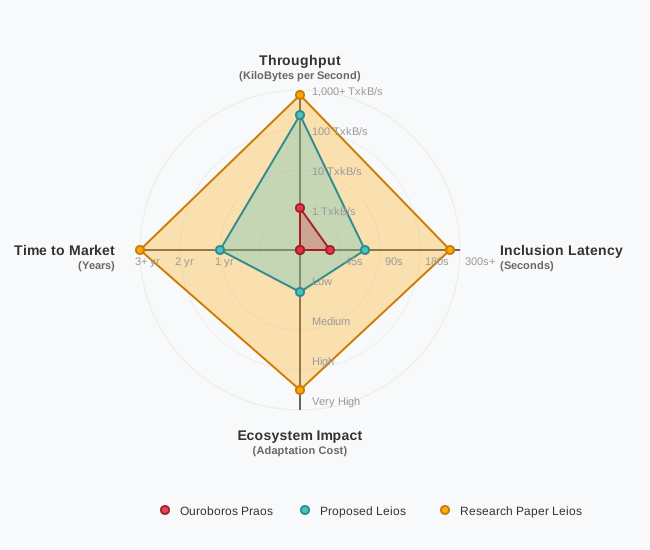
The comparison illustrates the fundamental trade-off between throughput capacity and ecosystem disruption. While the research paper's approach (orange) achieves higher throughput, it requires extensive ecosystem changes, significantly longer confirmation times (2-3 minutes), and extended development timelines (2.5-3 years). The proposed specification (teal) strikes a strategic balance, delivering substantial throughput improvements while maintaining manageable latency increases and ecosystem compatibility.
Key Trade-offs:
- Throughput: 30-65x increase (from ~4.5 TxkB/s to ~140-300 TxkB/s) addresses economic sustainability and Reserve depletion timeline
- Transaction Inclusion Latency: Increases from ~20 seconds to 45-60 seconds
- Infrastructure: Requires modest hardware upgrades (4-core machines) and cryptographic key registration, offset by enhanced rewards
- Time to Market: ~1-1.5 years for deployment versus 2.5-3 years for higher-concurrency alternatives
Protocol Limitations:
The specification involves operational constraints including timing dependencies that require careful parameter tuning, confirmation complexity through multiple transaction states, and interdependent protocol parameters requiring ongoing optimization. These represent acceptable trade-offs for achieving substantial throughput improvements while maintaining familiar transaction structures and ecosystem compatibility.
Security Considerations:
The proposed specification maintains Praos security properties through formal timing constraints that ensure RB processing stays within Praos bounds. The high-participation design (75% voting threshold) eliminates invalid transactions in RBs and provides strong network assumptions for certified EB propagation. New threats include equivocation by EB producers/voters and transaction availability attacks, mitigated through cryptographic validation, equivocation detection, and the high voting threshold requirement. Comprehensive analysis is documented in the Protocol Security section and threat model.
Design Decisions
Voting committee selection
A stake cutoff is required: allowing every registered SPO to vote ("Everyone votes") leaves the committee size unbounded and vulnerable to an adversary registering pools to inflate vote traffic. Moreover, under realistic Pareto-distributed stake the marginal security gain of including additional small pools diminishes rapidly: on mainnet at epoch 649, 890 pools already cover 99% of active stake while the remaining 1,790 pools share under 1%. A committee size () chosen against that distribution captures this directly.
Given a stake cutoff, two committee-selection schemes were seriously considered: stake-based truncation (the scheme specified above) and wFA^LS (weighted Fait Accompli with Local Sortition; the scheme that appeared in earlier drafts of CIP-164). A detailed cryptographic analysis of both schemes is available in the ARC voting crypto review; the scheme specified in this CIP corresponds to "Truncation" in that report.
| Dimension | Stake-based truncation | wFA^LS |
|---|---|---|
| Voter set per epoch | Top-stake committee (bounded) | Persistent voters + per-EB non-persistent |
| Certificate format | Bitfield + aggregated signature | Bitfield of PVs + per-NPV eligibility proofs + aggregated signature |
| Committee size (mainnet ep. 612) | 916 seats (top-stake at 99% stake) | 481 PV + 94 NPV |
| Certificate size | ~203 B | ~6.8 kB |
| Cert verification | ~2 ms | ~10 ms |
| Vote size | 94 B | 94 B (PV) / 171 B (NPV) |
| Per-vote eligibility check | None (membership lookup) | BLS check + VRF check for NPVs |
| Network traffic at scale | Bounded by stake-distribution tail | Bounded by PV + NPV count |
| Adaptive security (with key rotation) | Yes (in practice) | Yes, with NPV non-targetability bonus |
| Implementation complexity | Small | Substantial (sortition, two vote shapes) |
(Numbers from leios-wfa-ls-demo benchmarks against mainnet stake data.)
Why stake-based truncation was selected:
- Certificate size dominates the design pressure. Certificates are perpetual on-chain overhead and certificate verification sits on the critical path. The ~33× certificate-size reduction and ~5× verification-time reduction relative to wFA^LS is a substantial ongoing protocol-level saving.
- Simplicity. No per-EB sortition, one vote shape, one eligibility check. This is "harder to get wrong" across multiple node implementations (cardano-node, amaru, and others). The conformance test surface is correspondingly smaller.
- Adaptive security gap is small in practice. Without BLS key rotation, no scheme is genuinely adaptively secure. With rotation, the one feature wFA^LS uniquely retains is non-targetability of NPVs — but NPVs are drawn from the long tail of small pools, so compromising them yields very little stake per target. A rational adaptive attacker would focus on the large persistent voters regardless, where both schemes are equally exposed.
- Reversibility. The committee scheme can be changed in an intra-era hard-fork via a protocol parameter, provided the parameter is chosen to generalize across schemes. A seat count () does: every scheme considered here is naturally parameterized by how many seats it fills (wFA^LS by its persistent and non-persistent seat counts, wFA^IID by its bounded per-EB vote count), whereas a cumulative-stake target only has a meaning under truncation. Locking in stake-based truncation now does not foreclose future revisitation if simulation or operational data warrant it.
The adaptive-security argument above is contingent on BLS key rotation (Appendix A requirement 2). The on-chain mechanism — extending the pool registration certificate to carry the voting key, with epoch-boundary activation aligned to VRF-key rotation — is specified under Key Registration and Rotation. The static-vs-adaptive distinction applies equally to all schemes considered here (stake-based truncation, wFA^LS, and All-vote alike), so the relative comparison above is unaffected.
Why the committee is sized directly. Earlier drafts configured the committee by a cumulative-stake target () and let the seat count follow, to guard against a flattening stake distribution under-representing active stake in the committee. That concern belonged to wFA^LS, not to the cutoff: local sortition sampled the distribution for its non-persistent seats, so a fixed seat count had to be sized against the sampling error, and a flatter distribution really did degrade how well the drawn seats represented stake. Stake-based truncation draws nothing. Each seat is one pool and carries exactly that pool's stake, the quorum is evaluated on stake rather than on head count, and a certificate proves the stake predicate directly, so no seat count, fixed or otherwise, can mis-weight a pool.
What a seat count does determine is how much stake is eligible at all, which under a flattening distribution means less coverage rather than distorted coverage. That is a liveness margin, not a security property: it is bounded below by , has ~24 points of headroom at the recommended value, drifts over epochs rather than blocks, and is readable off the chain at any time. Sizing the committee directly therefore lets governance hold constant the quantity the network must budget for, votes per EB and certificate bytes, and absorb stake drift in the quantity that has slack. Choosing the committee size works this through on current mainnet stake.
wFA^IID as a forward-looking option. A variant wFA^IID (Fait Accompli with IID stake-proportional sampling for non-persistent seats) is recorded here as the natural next step should stake-based truncation prove inadequate. It would be invoked specifically in the scenario where post-deployment network measurements show the absolute vote count under stake-based truncation placing unacceptable pressure on vote diffusion within . wFA^IID produces certificates and votes of the same size as stake-based truncation. Eligibility of a non-persistent seat is established by re-running a deterministic public sortition draw at epoch start, not by an in-vote eligibility proof, while offering a bounded number of votes per EB irrespective of how many pools are eligible. This trades implementation complexity (the per-seat sortition draw and the bookkeeping for multi-seat winners) for tighter network-load control without sacrificing the certificate-size advantage.
Caveat: Network-level simulations confirming that vote diffusion at the
expected vote counts does not exceed the budget have so far
been run on the mini-mainnet topology (750 nodes), and also on a
similarly-derived midi-mainnet with 1500 nodes, where both schemes behave
identically. To push the committee size to its limits, we also simulated an
'everyone votes' mode - literally everyone, even relays - giving a committee
size of 750 and 1500 respectively. Even then, the
protocol performed as expected, showing that committee size is not a significant
factor in performance. 1500 votes per EB is therefore the largest cardinality
analysed, which brackets the seats recommended in Table
7. Full results are available in the 2026w18 analysis.
Transaction References in Endorser Blocks
EBs contain transaction references rather than full transaction bodies to avoid re-transmitting data already diffused through the network. Nodes fetch only transactions they don't possess, reducing bandwidth and avoiding redundant validation when transactions are endorsed by multiple EBs. Complete transaction data remains available through network diffusion and local storage for immutable chain purposes.
Alternatives & Extensions
The presented Leios specification provides a solid foundation for progressive enhancement towards higher throughput while maintaining ecosystem compatibility. Several alternative ideas and protocol variants were considered, which are listed as possible extensions in this section.
As ecosystem priorities change, any of the following pathways could become more attractive to implement, each offering distinct trade-offs in terms of user experience, implementation cost, security considerations, and throughput potential.
Furthermore, most aspects build incrementally upon the base protocol and may form a roadmap of next steps.
Increase Praos Parameters
Enhancing Praos parameters through bigger blocks and higher active slot coefficients offers a direct pathway to improved throughput. Δ Q analysis and simulations confirm there is room for improvement, with analysis of 50 Tx/s and 100 Tx/s scenarios (84 TxkB/s and 172 TxkB/s respectively) demonstrating feasibility within current network constraints. The 50 Tx/s case would provide economically sustainable throughput, though RB diffusion approaches the assumption limits and leads to increased network forks. While this change alone does not provide significant room for future growth, it establishes a foundation for further enhancements.
As an extension, more frequent blocks rather than larger blocks could enhance Leios variants by enabling more frequent certifications and lower inclusion latency. This approach requires tighter constraints on EB diffusion but provides better user experience through reduced transaction confirmation times.
Relax EB diffusion constraints
The current design requires (worst case) to be fairly small to enable selection of reasonable values that ensure certified EBs do not impact Praos safety while maintaining frequent enough certification for high throughput. Should worst-case EB diffusion prove much larger than average or optimistic cases, introducing an additional recovery period after certificate inclusion could allow EBs to remain unavailable for extended periods.
This approach provides greater freedom in selecting parameters, potentially allowing values as low as zero. However, the security argument must account for nodes being unable to validate blocks within periods. To preserve Praos safety and liveness, this requires relaxed chain validity rules where potentially invalid transactions could be permitted in ranking blocks during recovery periods.
The increased protocol optimism enables higher throughput at the cost of significant complexity and downstream impacts on chain validity semantics. Light node use cases would be particularly affected, requiring full ledger state to determine transaction validity during periods. Correction mechanisms through invalid transaction lists in subsequent certified EBs or ranking blocks could mitigate these issues, though at the expense of additional protocol complexity.
Transaction Groups
Transaction grouping mechanisms offer natural throughput optimization by reducing reference overhead in Endorser Blocks. Rather than individual transaction references, EBs could reference transaction groups, enabling inclusion of more transaction bytes within existing block size constraints. This enhancement requires no fundamental protocol changes if nested transaction approaches like CIP-118 provide the underlying grouping infrastructure. The approach maintains full compatibility with existing transaction validation while improving space efficiency.
Interaction with Peras
The integration pathway with Peras remains an active area of research, focusing on optimizing the interaction between Leios' enhanced throughput mechanisms and Peras' finality guarantees. Key considerations include synchronizing committee selection processes, coordinating voting mechanisms to avoid redundancy, and ensuring that enhanced throughput periods align effectively with finality checkpoints. This integration could provide both higher throughput and stronger finality assurances than either protocol achieves independently.
Decoupling EB Production
Introducing independent scheduling for Endorser Block production represents the first step toward concurrent block production. This approach separates EB cadence from Ranking Block timing through dedicated VRF lotteries or deterministic schedules, providing greater flexibility in optimizing diffusion timings and reducing censorship opportunities for stake-based attackers. While this introduces potential conflicts between transactions in RBs and those endorsed in EBs, the enhanced scheduling flexibility enables better parameter tuning for diverse network conditions.
EBs Referencing EBs
Building chains of certified Endorser Blocks before anchoring them to the main chain enables more granular transaction processing and improved inclusion latency. This approach allows multiple smaller EBs instead of monolithic blocks, reusing validation and voting work already performed while continuing transaction processing during periods of poor chain quality. The shorter possible cadence particularly benefits scenarios with unfavorable RB sortition, providing more consistent transaction inclusion opportunities.
Input Block Production
Full concurrent block production through Input Blocks represents the highest throughput pathway but introduces significant complexity. This approach front-loads validation and diffusion work across multiple concurrent streams, substantially increasing transaction conflict likelihood even under honest operation. Resolution mechanisms include accepting conflicts with fee collection from non-executed transactions, reducing conflict probability through ledger sharding or controlled IB production, and implementing reconciliation systems with tombstoning to manage storage efficiency. While offering the greatest throughput potential, this pathway requires careful analysis of economic incentives and conflict resolution trade-offs.
Path to Active
Acceptance criteria
The proposal will be considered active once the following criteria are met:
- Protocol performance validated through load tests in a representative environment.
- Required changes are documented in an implementation-independent way via the Cardano blueprint including conformance tests.
- Formal specification of the consensus and ledger changes is available.
- ΔQSD model available for Leios parameter selection.
- BLS key rotation mechanism specified in this CIP — see Appendix A requirement 2.
- Community agreement on initial Leios protocol parameters.
- A peer-reviewed implementation of a Leios-enabled node is available.
- Successful operation with open participation in testnet environments over several months.
- Key infrastructure signaled readiness for Leios-enhanced throughput.
- Hard-fork enabling Leios is successfully executed on mainnet.
Implementation plan
Key steps on the roadmap to realize Leios, somewhat ordered but not sequential, are:
- Simulations to confirm general feasibility using a model of mainnet.
- Ecosystem impact analysis and establish a threat model.
- Coordinate with related activities on other protocol enhancements (Phalanx, Peras, Mithril).
- Detailed node-level (as opposed to this protocol-level) technical specification.
- Complete ΔQSD analysis of new/changed network interactions.
- Complete formal protocol specification in Agda of ledger and consensus changes.
- Create network prototypes and conduct large scale experiments.
- Load tests in a controlled topology
- Validate protocol parameters
- Stake- and network-based attacks
- Develop node-level, but implementation-independent conformance test suites (blueprint).
- Create a public Leios-specific testnet with repeated load tests and encourage dependant infrastructure updates.
- Implement / integrate necessary changes to
cardano-nodeand other node implementations (this is big). - Audit protocol and implementation changes.
- Align on node releases and hard-fork schedule to mature pre-releases through preview and preprod testnets.
Versioning
Leios changes the consensus algorithm used to create a valid chain on Cardano and thus requires a new major protocol version. As the block format will change, a new ledger era is also required and CIP-84 applies. A hard-fork event will enable Leios on the Cardano network and the usual mechanisms of governing a hard-fork will be employed.
References
Primary Documents
- CPS-18: Greater transaction throughput — CPS-0018
- Ouroboros Leios: Design Goals and Concepts — Research Paper
Leios Resources
- Leios R&D website — leios.cardano-scaling.org
- Leios Discord channel — IOG Discord
- Leios R&D repository — ouroboros-leios
- Leios formal specification — ouroboros-leios-formal-spec
- Leios Agda formal specification — ouroboros-leios-formal-spec
Technical Reports
- Voting scheme analysis — leios-wfa-ls-demo: explores wFA^LS on mainnet stake data and includes vote/certificate size and verification benchmarks for the stake-based committee scheme
- ARC voting crypto review — ouroboros-leios/arc-voting-crypto-review.pdf: cryptographic analysis comparing All-vote, Truncation (the scheme in this CIP), and wFA^LS on adaptive-security and overhead grounds
- Older cryptography prototype — ouroboros-leios/crypto-benchmarks.rs: explores wFA^LS BLS certificates and sortition
- Older committee size and quorum requirement — Analysis: establishes lower bounds on committee size and quorum fraction; analysis was conducted in terms of vote counts but the bounds apply equally when the quorum is expressed as a stake threshold
- Threat model — Report
- Node operating costs — Cost estimate
- Impact analysis - Impact
Related
- CPS-0017 — Settlement layer CPS
- Praos performance model — Specification
Simulation Resources
- Synthetic mainnet — Mainnet-like topologies for Leios
- 10k-node network — Leios pseudo-mainnet topology
- 750-node network — Leios mini-mainnet topology
- Comparison of 10k-node and 750-node networks — Mainnet comparison study
- Validation times — Analysis of mainnet transaction validation times
External
- RIPE Atlas — Network measurements
- Ledger analyser tool — db-analyser
- UTXO-HD — Cardano Node 10.5.1
- SPO hardware requirements — Minimum hardware requirements to run a stake pool
Appendix
Appendix A: Requirements for votes and certificates
The voting and certificate scheme for Leios must satisfy the following requirements to ensure security, efficiency, and practical deployability:
-
Succinct registration of keys: The registration of voting keys should not involve excessive data transfer or coordination between parties. Ideally, such registration would occur as part of the already existing operational certificates and not unduly increase their size.
-
Key rotation: The cryptographic keys used to sign Leios votes and certificates should support periodic rotation to strengthen the scheme against adaptive adversaries who may target known committee members.
-
Deterministic signatures: While deterministic signatures can provide additional protection against attacks that exploit weak randomness in signature generation, they are not strictly required for protocol security. The main requirement for deterministic randomness is in the lottery mechanism, which is satisfied by the use of VRFs.
-
Committee privacy: Committee selection may be public and deterministic. Leios is an optimistic overlay protocol: attacking certification does not impact safety of the underlying chain, only liveness of the EB certification path. Key rotation (requirement 2) mitigates targeted attacks on known committee members.
-
Liveness: Adversaries with less than 50% of stake should not be able to thwart an honest majority from reaching a quorum of votes for an EB.
-
Soundness: Adversaries with near majority stake (e.g., 49%) should not be able to form an adversarial quorum that certifies the EB of their choice.
-
Small votes: Because vote traffic is large and frequent in Leios, the votes themselves should be small. Note that the large size of Praos KES signatures precludes their use for signing Leios votes.
-
Small certificates: Leios certificates are included in ranking blocks and must be small and quick to validate. Compact certificates improve RB diffusion speed and thus the safety margins of the protocol. Note that certificates based on Praos KES signatures are too large for consideration in Leios.
-
Fast cryptography: The computational burden of creating and verifying voting eligibility, the votes themselves, and the resulting certificate must be small enough to fit within the CPU budget for Leios stages.
The aggregate signature scheme implementation specified in this document (using BLS as an example) satisfies all these requirements, as evidenced by the performance characteristics and certificate sizes documented in the Votes and Certificates section.
Appendix B: Wire Format Specifications (CDDL)
This appendix contains the complete CDDL specifications for all Leios protocol messages and data structures. These definitions specify the exact wire format for network communication. This appendix also defines the CDDL encodings for the BLS cryptographic objects (verification keys, signatures, and proofs-of-possession) used by Leios voting and certification.
 ranking_block =
   [ header                   : block_header
   , transaction_bodies       : [* transaction_body]
   , transaction_witness_sets : [* transaction_witness_set]
   , auxiliary_data_set       : {* transaction_index => auxiliary_data}
   , invalid_transactions     : [* transaction_index]
+  , ? eb_certificate         : leios_certificate
   ]

block_header =
   [ header_body              : block_header_body
   , body_signature           : kes_signature
   ]

 block_header_body =
   [ block_number             : uint
   , slot                     : slot_no
   , prev_hash                : hash32
   , issuer_vkey              : vkey
   , vrf_vkey                 : vrf_vkey
   , vrf_result               : vrf_cert
   , block_body_size          : uint
   , block_body_hash          : hash32
+  , ? ( announced_eb         : hash32
+      , announced_eb_size    : uint32
+      )
+  , ? certified_eb           : bool
]endorser_block =
[ transaction_references : omap<hash32, uint16>
]
; Ordered map type definition
; An omap behaves like a map but preserves insertion order and prevents duplicate keys
; This ensures deterministic serialization while maintaining transaction sequence
omap<K, V> = {* K => V} ; Order-preserving map with unique keys
; Legacy reference structure (for documentation)
; tx_reference =
; [ tx_hash : hash32 ; Hash of complete transaction bytes
; , tx_size : uint16 ; Transaction size in bytes
; ]leios_certificate =
[ signers : bytes ; bitfield over the epoch's committee, MSB-first; bit i set iff voter_id = i signed
, aggregated_signature : leios_bls_signature
]
leios_vote =
[ announcing_rb_hash : hash32 ; the signed message; hash of the RB header announcing the EB
, voter_id : uint ; index into the epoch's stake-based committee
, vote_signature : leios_bls_signature
]Neither structure repeats the announcing RB's slot or the EB hash. A vote is
verified against the announcing_rb_hash it carries, and a certificate is
verified against the announcing RB determined from the certifying RB's own chain
context, so both are redundant on the wire.
The signers bitfield is ⌈N/8⌉ bytes where N is the committee size for the
epoch in which the announcing RB was produced: the committeeSize protocol
parameter , or the number of registered pools if that is smaller. The
committee itself is derived deterministically from the active stake distribution
(see Committee Selection), so no per-vote eligibility
proof is carried in either the vote or the certificate.
Leios uses BLS12-381 MinSig (small signature, large verification key):
- Verification key: compressed G2 = 96 bytes
- Signature: compressed G1 = 48 bytes
- Proof-of-possession: compressed G1 = 48 bytes
MinSig is chosen because vote traffic — not certificate size — dominates the on-wire cost of the voting layer once the certificate collapses to a single aggregated signature. The single signature in a certificate is 48 B under MinSig vs 96 B under MinPk; an individual vote is 48 B + overhead vs 96 B + overhead. Verification keys are referenced indirectly through the committee bitfield rather than carried per-vote, so MinSig's larger 96 B keys do not appear on the wire at vote time.
; BLS12-381 MinSig encodings for Leios
leios_bls_verification_key = bytes .size 96
leios_bls_signature        = bytes .size 48
leios_bls_pop = bytes .size 48Registering a voting key extends the existing stake pool registration
certificate with an optional bls_key field that may also be nil (for
backwards compatibility). A pool that has not registered a voting key occupies a
keyless committee seat (see Key Registration and
Rotation):
 pool_registration_cert = (3, pool_params)

 pool_params =
   (   operator       : pool_keyhash
   ,   vrf_keyhash    : vrf_keyhash
+  , ? bls_key        : bls_key/ nil
   ,   pledge         : coin
   ,   cost           : coin
   ,   margin         : unit_interval
   ,   reward_account : reward_account
   ,   pool_owners    : set<addr_keyhash>
   ,   relays         : [* relay]
   ,   pool_metadata  : pool_metadata/ nil
   )

+bls_key =
+  [ leios_bls_verification_key
+  , leios_bls_pop
+  ]
Copyright
This CIP is licensed under Apache-2.0.